|
fresh food deliveries
Ready prepared
Fresh prepared food deliveries – meals delivered to order and ready to eat – are a growing industry, as busy consumers choose to control their nutritional and calorie intake by passing responsibility for this to the experts.
Spas have the opportunity to move into this market on a joint venture basis, by lending their name and nutritional expertise to create branded ranges of home delivered spa food.
This will enable busy consumers to enjoy spa-quality fresh food at home, as part of their weight management, weight reduction or wellness management programmes.
Apart from the profits which could accrue from this type of deal, spas would also gain valuable brand profile from being part of people’s everyday lives and the consumer connection could be used to market further spa visits with on-package promotions.
Spas could sign-up guests for home delivery services during their spa visit when their intentions are most resolute.
|
|
|
Online Reviews
Star Performance
Online reviews are having a huge impact on service businesses and although spas have yet to embrace them to the degree seen in the hotel and restaurant sectors, the opportunity is there to increase business by encouraging and managing reviews.
A study by economists at the University of California, Berkeley found a variance of just half a star rating can determine whether a business thrives or goes bust. Researchers focused on restaurant reviews on Yelp.com and found that the difference between 3 and 3.5 stars increased the chance of a business reaching capacity at peak times from 13 per cent to 34 per cent.
Further reinforcement comes from a TripAdvisor study which found that properties with 11 reviews or more see a 28 per cent rise in user engagement when compared to those with 10 or fewer.
Dealing well with complaints relating to online reviews is also important according to a PhoCusWright report which found that 84 per cent of TripAdvisor users said an appropriate management response to a bad review improves their impression of a hotel.
See Spa Business, issue 1, 2013, p26 for a more detailed look at how to effectively handle online customer reviews.
| |

|
| PHOTO: Shutterstock/wavebreakmedia |
Time to get serious about online reviews |
|
|
|
Wearable tech
Google glass
We’re moving from an era when we interface with technology using a keyboard and mouse, to a time where touch and voice are the new norm and putting on our wearable technology – watches, glasses, sensors and controllers – is just routine.
It will give us voice-activated access to a wide range of functionality. Enabling us, for example, to have a display in our field of vision, to film and take pictures with ease, and to search, translate, communicate and share on the go.
Wearable tech will find business- and consumer-facing applications in the industry. Google Glass, for example, Google’s augmented reality glasses, and rival Telepathy One, which enable the capturing and sharing of video from a users’ eye view, will be used by spa trainers to share coaching demonstrations in real-time, while customers will be given Google Glass pre-loaded with relaxation content to create an augmented reality experience.
We’ll need protocols to deal with wearable tech too – will we allow it to be worn in spas?
The growth in image-based technology is also turning photography and video into communication mediums that replace words in some contexts – a valuable resource in an increasingly global economy.
| |

|
| PHOTO: GOOGLE |
Google Glass will bring augmented reality to the mass market |
|
|
|
Death
End of life care
There’s an increasing interest in having a ‘good death’ which avoids unnecessary medical intervention and with an ageing population, the number of people dying each year is increasing, making it a major growth market.
This gives experts and operators in the spa industry a business opportunity to develop a new category of specialist, spa-inspired facilities, focused on death. They would give people have the chance to reflect and spend time with loved ones, while offering comfort, engagement, personal care, appropriate rituals and a spiritual dimension.
We believe end of life care is a market which is ripe for disruption.
|
|
|
Emotion
Engaging the heart
Considering the spa industry aims – and claims – to be holistic, a spa visit is normally an emotionless experience.
Spas focus on protocols and standard operating procedures and guests are asked to adhere to etiquette which prescribe controlled and passive behaviour with little or no room for emotion.
But being touched can be an emotional experience and humans are creatures of emotion so a truly holistic experience should be respectful of this.
On page 3, we explore the opportunity for spas to encourage more emotional responses from customers to deliver richer experiences.
|
|
|
Skills register
Get enlisted
This year, a global initiative by the Global Spa & Wellness Summit (GSWS), led by its Spa Management Certification Task Force, will define the role and skills necessary for spa managers/directors (see p146). The task force is headed by Lynne McNees – president of the International Spa Association.
It’s an important step in developing globally recognised standards for spa management and one which will filter down to spa management education and training (see SB13/1 p74).
In a study – Spa Management Workforce & Education: Addressing the Market Gap – commissioned by the GSWS and conducted by SRI International, one area highlighted for further discussion is the potential for “an industry-level accreditation for spa management training programmes/curricular that meet industry standards for quality and content”.
Something similar has already been successfully undertaken in the fitness industry with the creation of the Register of Exercise Professionals and the European Register for Exercise Professionals – registers for training providers and fitness professionals to verify that their qualifications meet globally recognised standards. And in January, UK trade body Habia (see p58) announced it will develop a professional register for spa, nail and beauty qualifications to measure existing qualifications against national standards.
We expect the spa industry to work its way towards national skills registers in the same vein and for these to eventually consolidate to form a global register of spa skills.
| |

|
| PHOTO: Shutterstock/lightpoet |
The spa industry can only achieve its full potential if it can attract and train great people |
|
|
|
Glute massage
The bottom line
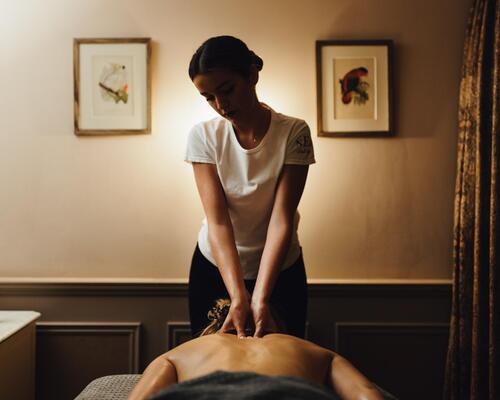
Experts advise that a significant percentage of back problems originate in the gluteal muscles, or are made worse by tension and misalignment in this area.
Treatment of the glutes is largely avoided for reasons of decorum, especially in the US, where strict draping rules apply. However, when done effectively, massage of the gluteals can release tension which affects the neck, back and legs.
As the spa industry continues to develop its holistic purpose, we expect technical, specialist, curative treatments such as glute massage to become more mainstream.
| |

|
| PHOTO: Shutterstock/ wavebreakmedia |
Treatment of the gluteal muscles can be effective in relieving back pain |
|
|
|
More with less
Getting creative
The recession put spa businesses under pressure to innovate without spending, so operators found ways to create value without increasing costs, using the same facilities and staff.
Much of this innovation has been around creating either new, customised or added-value experiences which are an upsell from standard treatment menus, creating a higher perceived value for consumers.
Future innovation is likely to follow this model, as economies rally and spas seek to achieve increases in income while maintaining lower cost bases.
|
|
|
Delicious extras
Small & powerful
We expect spas to customise more – the little things can make the biggest difference and they can be cheap to deliver. Wrap a customers’ feet in a blanket during a massage to keep them snug, steam or press clothes while they’re having a treatment or give a take home gift.
| |

|
| PHOTO: shutterstock/Andrey_Popov |
A small treat makes a big impact |
|
|
|
Pop-up spas
Nimble solutions
Investing in spa infrastructure is costly and bricks and mortar tie an operation to a specific location permanently.
We’re seeing early signs that the pop-up trend, which has taken retailing by storm, will make its way into the spa market, creating opportunities for operators to extend their brands and try out locations on a low-cost basis, before making a more costly investment in permanent operations.
Pop-ups can be more innovative and playful, offering greater freedom in their delivery, and can create new audiences by attracting consumers who are drawn to a more edgy offering, but who may not normally frequent spas.
| |

|
| PHOTO:360 design by matthew david |
French brand Evian, which announced its move into spa in 2012, has a pop-up concept |
|
|
|
New allies
Shared aims
The industry will become more aware of its natural allies: governments seeking to reduce healthcare bills and boost wellness tourism, corporations which see commercial value in a healthier workforce and consumers who want to take charge of their own health.
Working with the first two groups, spas will extend services into new environments – government-run facilities will open accessible spas which can be used by the mass market and corporations will embrace spa – some by opening their own facilities and others by subsidising their employees to use external spas and services. We expect to see more partnerships developing between the spa industry and these powerful stakeholders.
| |

|
| PHOTO: shutterstock/ Konstantin Chagin |
The industry will seek out allies with shared goals and values |
|
|
|
Cellulite
a female obsession
For years manual lymphatic drainage and suction were spa’s cellulite-targeting options, but technological advances have led to a surge of newcomers such as Mesotherapy, VelaShape, cavitation and cryolipolysis. We expect this market to grow, especially in Italy and Brazil, where demand for cellulite treatments has always been high.
|
|
|
Home spa
Personal spaces
The already popular trend towards home spa treatments will evolve to the next level, with people choosing to add spa facilities to their homes.
This won’t just be the preserve of the super rich – although they’ll continue to invest in substantial spa-standard facilities – more ordinary working people will add steamrooms, heat experiences such as saunas and infrared rooms, whirlpool baths, gyms and meditation spaces. The trend towards therapists paying home visits will continue.
Spas may view this as competition, but consumers’ deeper commitment to a spa lifestyle will mean they’re engaged in these routines more of the time and this will increase the amount of focus they have on self-care, creating opportunities for spas to function at the core of their world, acting as the repository of knowledge. These consumers are likely to visit the spa more as a result of this higher level of involvement.
|
|
|
Childhood obesity
Teaching self-care
Few segments of the population will benefit more from the expertise, programmes and facilities of spas than overweight and obese children and teenagers.
More young people are growing up lacking the knowledge needed for effective self-care and spas are ideally placed to provide it.
Creating specialist spas for kids will not only make business sense, but will also enable the industry to bond with the next generation of spa goers.
Parents who lack the knowledge to help, or find they’re unable to advise and teach in a way their kids can accept, will welcome the opportunity to set them on the right path in life and to ingrain good lifestyle habits. Family counselling and intervention will also be offered.
|
|
|
Mobile biometrics
Expert engagement
Consumers can monitor all elements of their health – from stress levels to sleep patterns – via biometric readers. This presents spas with an exciting opportunity for constant engagement with customers.
We see a time when spas offer apps which firstly monitor and analyse all clients’ key health indicators and then give lifestyle advice based on the findings via wearable tech (see p130). This advice can be given in real-time so people can make better choices, such as how many more calories can be consumed that day, when a test is needed or when it’s time to take a break.
This level of engagement with customers will keep spas top of mind with tech-savvy customers and boost repeat visits.
| |

|
| Photo: bodymedia |
Customers will stay connected to the spa |
|
|
|
Sex in spas
No longer taboo
With some of the world’s most prestigious, well-respected spas beginning to hire out their couples rooms by the hour and the growth of couples treatments outstripping that of single treatments for some, sensual time spent with a partner is good for business.
Couples rooms are becoming more lavish and now routinely feature beds or lounging areas, double whirlpools and other private facilities, while treatments factor in alone-time behind locked doors, champagne and other treats, to create the perfect ambience.
It’s appropriate that spas, with their focus on the holistic, are moving in this direction, as our sexuality is an important part of our wellbeing. We expect this trend to evolve, with a focus on developing these options in a wholesome way with sensitivity and integrity.
Sex in spas is consistent with the industry’s spiritual ethos and just as friends are more likely to enjoy and wish to repeat their spa experience as a result of companionable time spent together, so attracting couples brings the benefits of repeat visitation, increased retail spend and opportunities to upsell by adding treatments to basic facility-use charges.
The industry is aware of the importance of retaining a highly professional reputation around this type of offer, especially in parts of the world which have suffered from links with the sex-trade – so the growth of couples bookings is being played down – and understandably so. However, we anticipate this trend will grow.
| |

|
| Photo: shutterstock/ Tyler Olson |
Sensual time with a partner is proving to be good for business |
|
|
|
Spa Brands
Moving in on retail
For years spas believed they had to offer product lines which weren’t available on the high street and although this still works for many, times change and there’s now an awareness that consumers are attracted to brands they trust and this had led to two changes. Firstly, spa brands are working to build consumer awareness and exploring direct retail sales, with some, such as Caudalie and Aromatherapy Associates launching high street stores. Secondly, existing consumer brands like Clarins, have moved into the spa market and are helping spas to boost their retail sales.
Consumer spend on body and facecare products is increasing and this will drive increasing activity in this sector.
|
|
|
Hand & arm massage
Smartphone relief
People are experiencing pain in their hands and arms from smartphone overuse and this is creating an opportunity for spas to offer specialist treatments designed to break down adhesions and release tension in these areas.
The hands and arms are largely overlooked during a routine massage, but we predict training bodies responsible for massage protocols will ramp up the proportion of time spent on them, as well as teaching techniques to address these issues. We also foresee a time when hand and arm massage is offered as a stand-alone treatment.
|
|
|
Repeat business
Keeping loyal
It’s a given that roughly 80 per cent of sales come from 20 per cent of customers, with some spas reporting levels of up to 90:10.
This means regular customers are like gold dust and we’ll see an increased focus on their recruitment and retention.
Regulars spend more, if they’re local, they’re more likely to use the spa at off-peak times and they’re important in buffering fluctuations in the number of tourists and ad hoc guests who come through the door.
Reward and membership schemes can keep clients coming back for more. Futurist Edie Weiner – a popular speaker at the 2010 Global Spa Summit in Istanbul – says reward points are the second largest currency in circulation worldwide after the US dollar, suggesting loyalty points could become a ‘new currency in spas’ and an effective way of encouraging repeat visits.
| |

|
| PHOTO: shutterstock/ Robert Kneschke |
Loyal customers can contribute up to 90 per cent of spa revenue |
|
|
|
Africa
In sight of change
Back in 2003, Goldman Sachs coined the term BRIC – the acronym for Brazil, Russia, India and China – to group together what it predicted would be the world’s dominant economies by 2025.
Next the CIVETS were identified as being the ones to watch: Columbia, Indonesia, Vietnam, Egypt, Turkey and South Africa – this acronym was coined by Robert Ward at the Economist Intelligence Unit in 2008 to predict the next generation of emerging economies.
We think much of the rest of Africa will show exciting growth over the next two decades, with the spa industry already identified as a driver for both domestic and inbound tourism markets. This will be especially exciting in nations which have developing middle classes and growing tourism infrastructure.
With his Kenyan roots, we believe Barack Obama will turn his attentions to the development of Africa at the end of his second term in office.
| |

|
| PHOTO: reuters |
Barack Obama at the University of Johannesburg, Soweto, South Africa, 29 June, 2013 |
|
|
|
Variable pricing
Software support
Using daily deal websites has given some spas a taste of the shape their businesses would be in if they could optimise yield and sell more off-peak time.
But although daily deals have been good for some operators, businesses ultimately want to take advantage of better yield without surrendering a percentage of revenue to deal sites.
This year we’re seeing a new trend emerging, as the leading software providers add yield management functionality to their systems, giving spas the tools to take more direct control of their variable pricing and marketing and meaning less reliance on deal sites.
Where deal sites are still used for marketing, spas which use this software will be able to upload new deals directly from their yield management systems. They’ll also be able to design better deals, based on the knowledge gleaned from these systems – both for third party distribution through deal sites and for their own direct marketing.
|
|
|
Last impressions
Powerful recall
Spas focus on creating a great welcome, but evidence suggests customers are more likely to remember the last thing that happened to them than the first*.
Spa operators need more emphasis on making a great last impression to ensure customers come back for more. * Credit: Jeremy McCarthy
|
|
|
Exercise
The key to wellbeing
Two things are happening in the world of fitness and exercise which have important implications for spas.
The first is that the growing body of evidence about the value of exercise is showing clearly and beyond doubt that it’s the biggest determinant of longevity and wellbeing, trumping all other factors. In this handbook we give a round-up of some of the latest findings (see p134).
The second is that exercise scientists are using this research to create a new generation of exercise protocols which are more effective and also suitable for use in spas. These include high intensity training (HIT) which comes in many forms, such as Tabata, which is based around four minute workouts and Vasper, which combines cooling and compression to biomimic the physiology of children and convince the brain it’s been exercising hard for several hours, rather than just 20 minutes.
There are also technological innovations coming to market which can be adopted by spas, such a virtual trainers – high-level experts are videoed delivering classes and these are played back via big screens to enable classes to be held at any time.
We believe, in short, that it’s time fitness was taken far more seriously by spas.
| |

|
| PHOTO: tabata |
Rapid change in the world of exercise is opening up new opportunities for spas |
|
|
|
Hospital spas
Provable outcomes
The spa industry is working to develop its credibility and show provable outcomes for its treatments. If this continues, we expect spa to become valid partners for the medical sector, with facilities being developed alongside hospitals.
The launch of the website spaevidence.com in 2011 – which gives search access to existing research on spa modalities from four medical websites – helped accelerate this process.
A number of treatments which are traditionally delivered in spas are as effective or more effective than the allopathic alternative and with pressure on government health budgets, the economics of this will drive decision-makers in the medical sector to seek out collaborations with spas.
Other factors will come into play too: private patients will demand spa treatments in hospitals for their life-enhancing and medical value and research into the placebo effect will show that spa treatments are some of the most powerful deliverers of these benefits.
| |

|
| PHOTO: shutterstock/ deepblue-photographer |
Spas will be built within hospitals as the efficacy of treatments is proven |
|
|
ABOUT THE AUTHORS |
Liz Terry has been writing about and analysing the global leisure industries since 1983. She’s editor of Spa Business and Spa Opportunities magazines.
email: [email protected]
twitter: @elizterry
Katie Barnes has a 12-year career in international spa, beauty and health media. She’s managing editor of Spa Business magazine and was launch editor of the Spa Business Handbook.
email: [email protected]
twitter: @SpaBusinessKB
|
|
|
|
|
|
|
|
|

|
|
|
Saskia Spa
Founded in 2014, Saskia Spa continues to evolve as a professional luxury skincare brand. It forms pa [more...] |
|
|
|
|
|
|
|
|
 |
|
| DIARY |
09-12 Jun 2026
W3Spa EMEA
Hotel Cascais Miragem Health & Spa,
Portugal
|
|
|
|
|
|
|
|
| |
|
|
|
|
|
| | | | | | | | | | | | | | | | | | | | |