In today’s premium spa environment, every detail shapes the guest experience – right down to
the softness of towels and the freshness of linens. ... more
The caveman diet, the 5:2, meal replacement shakes, green juices… What works and where can people turn for good weight management advice? It could, and should, be health
clubs. Kath Hudson reports
Clubs could use social media to create an online support network of people on diets / PHOTO: SHUTTERSTOCK.COM/HUGO FELIX
Despite a steady stream of fad diets and a rise in bariatric surgery, the nation gets ever fatter. Invariably diets only offer short-term results, which lead to yo-yoing weight and heartache.
The fitness industry is well positioned to make a difference to the nation’s health in this respect, but is its weight management offering as strong as it could be? Amid rumours that slimming giant Weight Watchers is in talks to buy virtual coaching company Wello, and with supermarket chain Tesco launching a healthy eating range supported by an online diet programme, what can clubs do to get their weight management offering up to scratch?
BE SOCIAL According to Mike Loosemore, consultant in sport and exercise medicine at University College London (see also p36), people’s chances of changing their behaviour triples if support is offered. Health and wellbeing coach Pete Cohen agrees, suggesting that clubs immediately find out people’s objectives when they join, establish what they’re prepared to do, prescribe a diet and regularly give them support, including using social media to create an online community of people on diets.
Perhaps even more interestingly, Loosemore says adding a monetary stake can further raise the likelihood of positive behaviour change.
A number of weight loss websites have sprung up around this thinking, creating communities of those trying to lose weight. For example, Stick asks users to give money to a charity they don’t like if they don’t meet their goals: apparently the George W Bush Presidential Library and Museum is doing very well out of the site. Diet Bet is another option, where users start a diet with friends, put down a wager and the one who loses the most weight wins the money. Innovative health clubs might want to create their own versions of these fun challenges in-club, and support them through social media.
Alternatively, apps could be used to similar effect. A new app, WatchFit, allows communities to be built up around specific plans. By following a programme, eating the correct meals and undertaking the workouts, points are accumulated and can be measured against whoever else the user has agreed to share information with. “It’s also a great way for trainers, conditioning experts and sports coaches to keep tabs on clients and ensure they’re following a prescribed plan,” says WatchFit CEO Parisa Louie.
BE AMBITIOUS Stuart Stokes, director of Refer-all, argues that health clubs should be thinking more ambitiously and bidding for health contracts in the same way that Freedom Leisure and Aquaterra are already doing. “There’s a huge opportunity for the industry to run Tier 1 and Tier 2 contracts,” he says. “Don’t think it’s someone else’s job: go for it right now while there’s funding available. As an industry, we have a responsibility to do something.”
Lisa Taylor at Momenta agrees with Stokes: “Going forward there will be more commissioning opportunities to run weight management programmes on behalf of public health. Clubs need to learn the language and train the staff in coaching and facilitation skills. There needs to be more understanding on interventions and behaviour change.”
Freedom Leisure launched its Tier 2 weight management service for East Sussex County Council in April. The scientifically designed programme – called re:balance – meets NICE guidelines and helps people lose weight and keep it off. It focuses on helping people make changes to their lifestyle, as well as their patterns of thinking and feeling, while losing weight at a healthy rate of 1–2lbs a week. Participants are involved in shaping the programme, and are guided towards activities they are interested in. There’s a group session each week to discuss progress, cover the lifestyle topics of the week and set daily and weekly targets, such as eating five portions of fruit and vegetables each day.
“re:balance is part of a commissioned service which covers the cost of operation,” says Richard Bagwell, Freedom’s sports and development manager. “It helps broaden our appeal to a new user group, uses space during off-peak times, empowers fitness instructors and is an exciting new development for us.”
According to Stokes, the only key skill that health clubs are generally missing is motivational interviewing. Credible two-day courses are available through the Motivational Interviewing Network of Trainers.
Freedom Leisure uses a programme written by Dr Tim Anstiss, who also trained the staff in motivational interviewing. Programmes then need to meet NICE guidelines; the blueprint for these services is available from Public Health England.
BE LONG-TERM Taylor also argues that a good weight management programme can be delivered by non-experts, but needs to be written by experts in three fields: nutrition, activity and psychology.
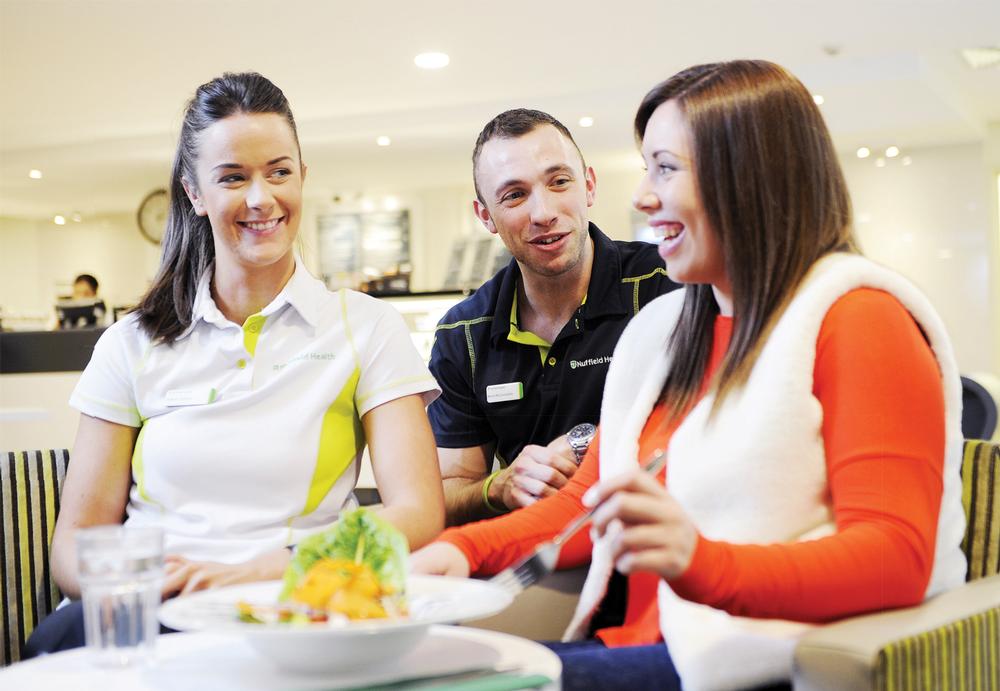
“These programmes have to be robust, credible and evidence-based, because otherwise they might be popular in the short term, but won’t have any traction long term because they won’t work,” she adds. Nuffield Health is a good example, drawing on its medical expertise to launch a clinically recognised weight management programme at the end of the year. In the meantime, as part of its wellbeing membership, it already offers a health mentor to guide people on making the right choices to achieve their health goals on an ongoing basis. Nuffield talks to the individual to find out what’s stopping them from losing weight, which unhealthy habits need to be changed, and what are the triggers that make them over-eat. As Tiffeny Cutts, who designs the programmes for Everyone Active’s new public health division Everyone Health – including adult, child and family weight management programmes – concludes: “Fad diets can deliver weight loss, but the health club industry could provide the missing piece of the jigsaw: sustained weight loss.”
Nuffield’s wellbeing members have access to a personal health mentor
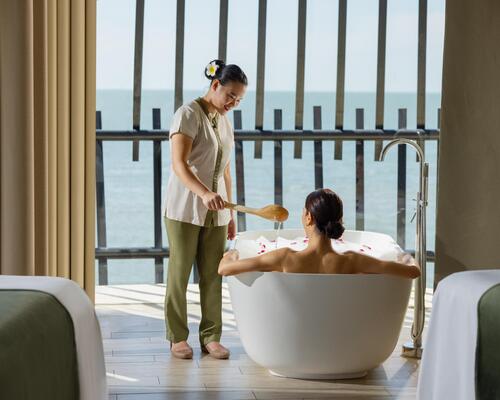
Four Seasons Resort The Nam Hai in Hoi An, Vietnam, has put together a Global Wellness Day
(GWD) agenda with activations rooted in nature and shaped by four pillars of Joy – in
alignment with the day’s theme #JoyMagenta.
The Global Wellness Summit (GWS) will celebrate its 20th anniversary at the 2026 event in
Phuket, Thailand, later this year with the theme: The Science, Art and Soul of Wellness.
Auko, an all-inclusive development, is opening in Phong Nha in Vietnam in Q3 2026, with a
series of 30 tented eco-lodges and wellness hospitality operations by Lumina Wellbeing.
Therme Manchester’s 28-acre development, which will include interconnected glass pavilions
that measure 65,000sq m, will be the largest bathing and wellbeing attraction in the world once
complete, according to prof David Russell, CEO of Therme UK.
Naples Beach Club, a Four Seasons Resort, has opened a 2,800sq m spa called The Sanctuary,
with the design and concept inspired by the Native American people that populated Florida’s
Southwest coast – the Calusa.
Swire Hotels’ luxury hospitality brand Upper House has revealed it will roll out its two-day
House of Healing retreats at its three hotels in Hong Kong, Chengdu and Shanghai.
LVMH-owned beauty house Guerlain will launch up to five spas with partners a year as part of
its plan to expand globally, according to the brand’s international spa and wellness director,
Diane Davody.
A new global study by Kevin Kelly and Peter Yesawich, called WELLSurvey 2.0, has revealed
more than half of consumers in the UK, US and Germany would not choose numerous high-
profile wellness resort brands for a future trip.
Luxury hospitality and wellness pioneer Jeremy McCarthy has launched Leisure Alchemy, a
digital platform that will provide professionals with strategic guidance on how to build
transformational leisure experiences that drive profit.
+ More news
COMPANY PROFILES
marocMaroc Since its creation in 2007, MarocMaroc has invited the world to explore Moroccan beauty through a u [more...]