In today’s premium spa environment, every detail shapes the guest experience – right down to
the softness of towels and the freshness of linens. ... more
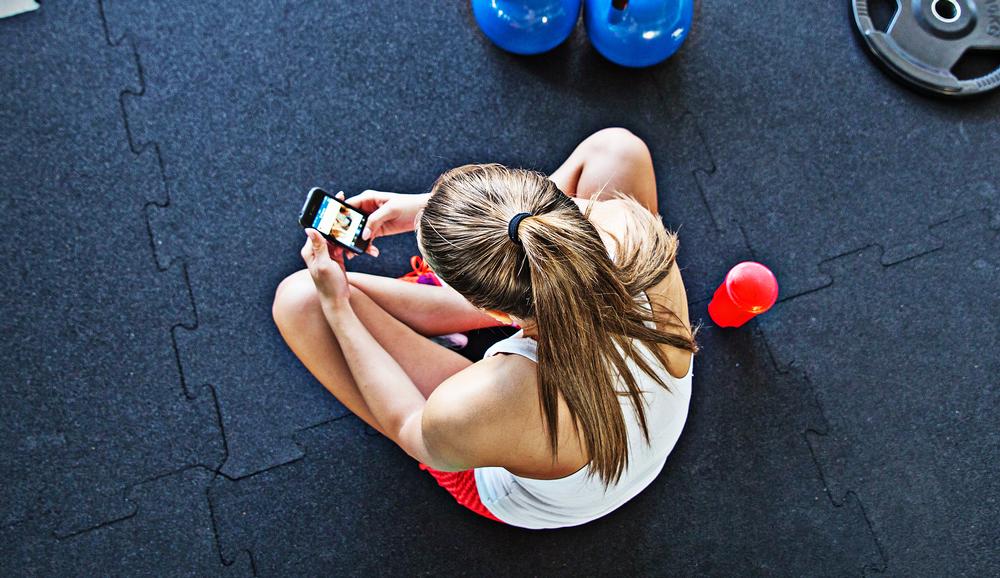
Club-based mobile apps have experienced an 11 per cent growth between 2013 and 2015 / Photo: shutterstock.com
Over the past decade, several fitness industry-serving organisations have put out studies that proclaim to have identified the fitness trends to watch.
Unfortunately, predicting trends takes more than asking people’s opinion – it requires digging down and understanding the behaviours of an industry. The American Council on Exercise (ACE), the International Health, Racquet and Sportclub Association (IHRSA) and ClubIntel therefore decided a ‘true trend’ report was needed – one that measured behavioural practices, looking at what the health and fitness industry was actually adopting and how adoption rates were changing over time.
Our collective goal was to identify what was ‘all the rage’ – in other words, what it is that currently occupies the pinnacle of popularity in our sector.
This article provides a brief glimpse into the work and the resulting outcomes which appear in both the executive summary and full report entitled 2015 International Fitness Industry Trend Report – What’s All the Rage.
Fad versus trend It’s important to understand the difference between fads and trends.
Fads are short-term phenomena that arise quickly, take the world by storm and just as quickly fade into obscurity. They span every aspect of human culture. In business they have been known to create mercurial success and mercurial failure. In social spheres, fads have created short-term changes in social consciousness that were just as quickly forgotten.
Fads are a virus that can quickly take over business thinking, sometimes generating short-term profit but more often than not causing permanent harm.
Conway Twitty, a singer from the 50s and 60s, said about fads: “Fads are the kiss of death. When the fad goes away, so do you.” It’s vital to see fads for what they are and not incorporate them as a central point of your business strategy.
Meanwhile, trends are events that evolve into movements. They have the ability to gain momentum and create long-term societal and business impact. Trends have vitality, often ingraining themselves within the cultural roots of society, whether it’s a social or a business trend. The power of a trend can manifest itself in the attitudes, values and behaviours of its audience.
Consequently it’s trends, not fads, that industry leaders need to focus on as they map out strategies for their businesses. As Bill Clinton, former US president, said: “Follow the trend lines, not the headlines.”
Rise and fall Understanding what’s ‘all the rage’ required us to conduct a two-dimensional analysis looking at the interplay between a trend’s level of industry adoption and its absolute level of growth. Where a trend falls in that matrix tells us if it’s emerging, growing, mature, in decline, or if it’s a niche trend rather than mainstream.
So what are the insights garnered from the study? For the purposes of this section, we’ve used the word ‘trend’ to define a specific practice of the industry; over time we will be able to establish whether they are actually trends or fads.
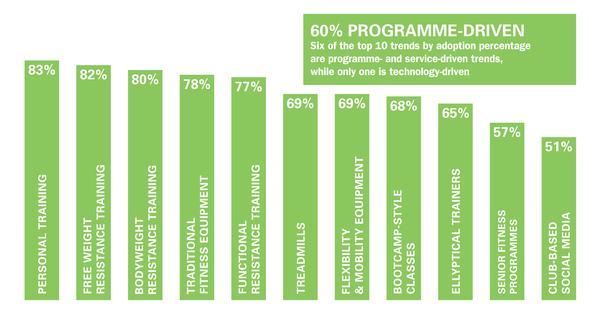
Among the top 10 trends by level of industry adoption, six are programme-driven, three are equipment-driven – and just one is technology-driven. In essence, what this speaks to is the health and fitness industry’s heavy reliance on programming, as well as its snail-like pace when it comes to adopting new technologies to enhance its value proposition.
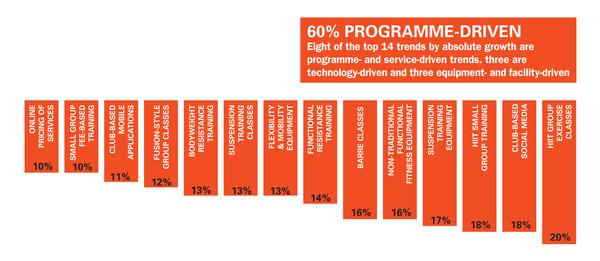
Among the trends with the greatest absolute growth over the past two years, 60 per cent are programme-driven – for example, HIIT classes, HIIT small group training, barre classes and suspension training. Three (21 per cent) are technology-driven: the use of social media, offering transparent online pricing of memberships and services, and the development of fitness club-based apps.
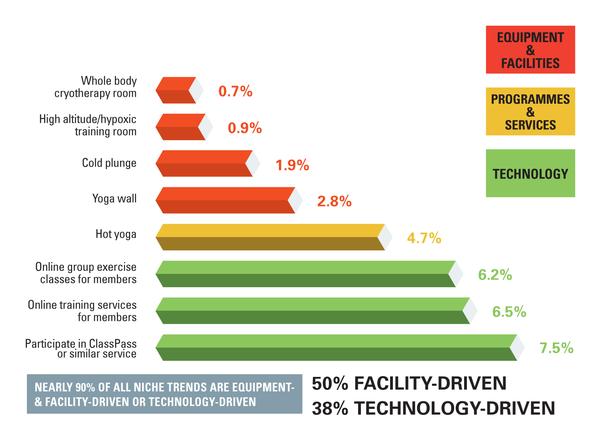
Among the eight trends that have captured less than 10 per cent of the industry – making them niche trends – three are technology-driven (such as online training offerings and the use of internet middlemen) and four are equipment-orientated (cold plunge, yoga wall, high altitude training rooms and whole body cryotherapy). Interestingly, only one programme trend – hot yoga – would fall into this segment.
Over the past two years, more than 20 trends have seen a decline in market penetration. Of the trends whose decline was more than 4 per cent, 80 per cent are programme-driven. When you factor in this statistic alongside the fact that 60 per cent of the fastest-growing trends are also programming trends, in our opinion this sector may be fad-driven more than it is trend-driven. We’ll be able to establish this once we have additional years’ data.
Notably, non-US markets have achieved considerably higher levels of adoption for technology-driven trends. This suggests the world market has been quicker than the US to adopt technology as part of its value proposition and operating platform.
Group cycling, traditional yoga and recumbent bikes were the only trends to be classified as mature. A large majority of the 90-plus trends measured fell into either the emerging or niche categories, indicating that in most cases, these trends may not evolve into mainstream trends.
PRACTICES SERVING NICHES IN 2015 Percentage adoption by health and fitness industry
PRACTICES SERVING NICHES IN 2015
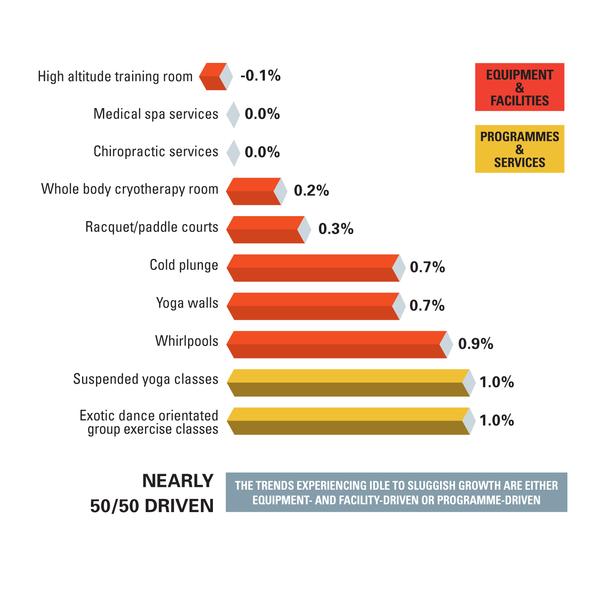
PRACTICES IN NEUTRAL FROM 2013-2015 Trends with less than 1% absolute growth from 2013–2015
PRACTICES IN NEUTRAL FROM 2013-2015
TOP 10 INDUSTRY TRENDS BY ABSOLUTE PERCENTAGE GROWTH 2013–2015
TOP 10 INDUSTRY TRENDS
TOP 10 INDUSTRY TRENDS BY PER CENT ADOPTION 2015
TOP 10 INDUSTRY TRENDS
WANT TO KNOW MORE?
During the second quarter of 2015, ACE, ClubIntel and IHRSA commissioned a fitness trend study among global health and fitness professionals. The study measured adoption rates and growth rates for over 90 fitness practices across multiple categories (programmes, services and training protocols, equipment and facilities, and technology) and industry segments (region, size of business, type of business model, and so on).
Special thanks go to Melissa Rodriguez of IHRSA, Todd Galati of ACE and Jim Peterson of Healthy Learning.
For further detail, please download the executive summary from ACE (acefitness.org), IHRSA (IHRSA.org) or ClubIntel (club-intel.com)
The full report can be purchased from the ClubIntel store (club-intel.com) or Healthy Learning (healthylearning.com) for US$99.95
The UK spa review and discovery platform for consumers, the Good Spa Guide, has announced
it will host the Good Spa Guide Awards 2026 during an event on 16 November at Sopwell House
Hotel in St Albans, UK.
Eighty-four per cent of consumers now say wellness is a top priority in their lives, with this
percentage increasing year on year, according to a preview presentation of McKinsey’s Future of
Wellness 2026 research report.
Mass protests have been taking place since Monday 1 June in Albania over the development of
a luxury resort by Donald Trump’s daughter Ivanka Trump and her husband Jared Kushner.
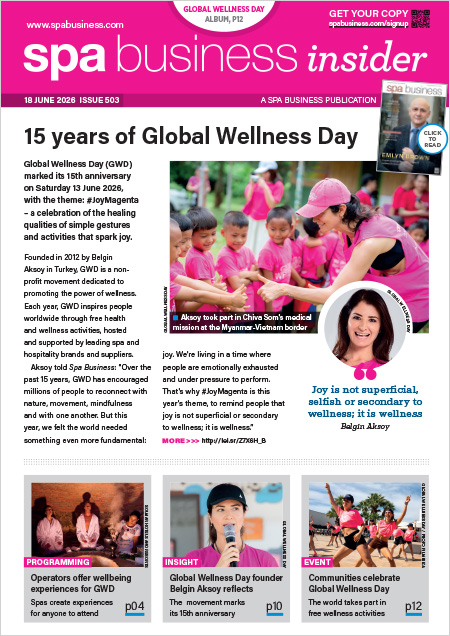
Global Wellness Day (GWD) marked its 15th anniversary on Saturday 13 June 2026, with the
theme: #JoyMagenta – a celebration of the healing qualities of simple gestures and activities
that spark joy.
Global luxury hospitality brand, Six Senses, has partnered with longevity healthcare provider,
HUM2N, to launch a clinic at Six Senses London, at The Whiteley.
As part of its first hotel partnership, Mayrlife – the medical health resort company known for its
site in Altaussee, Austria – has launched a day clinic at the Rosewood Vienna.
Premium London health club, KX Chelsea, will imminently unveil its most significant
redevelopment since its launch in 2002 to create an integrated wellness model combining
training, recovery and relaxation.
Rosewood Le Guanahani St Barth, on the northeast coast of Saint Barthélemy in the French
West Indies, is offering a programme of ocean-inspired yoga classes between 8-14 June to
celebrate Global Wellness Day (GWD).
Hotel de France, located on the British Isle of Jersey, has created a wellness retreat package
that includes a hot yoga session that will take place in Jersey Zoo’s butterfly sanctuary.
The Ritz-Carlton, Langkawi, in Malaysia, has revealed a schedule for Global Wellness Day
(GWD) that includes guided rainforest walks, mindful movement and guided coastal meditation
experiences.
+ More news
COMPANY PROFILES
Omnisens Rooted in nature and guided by a holistic philosophy, Omnisens' treatments and products are crafted [more...]