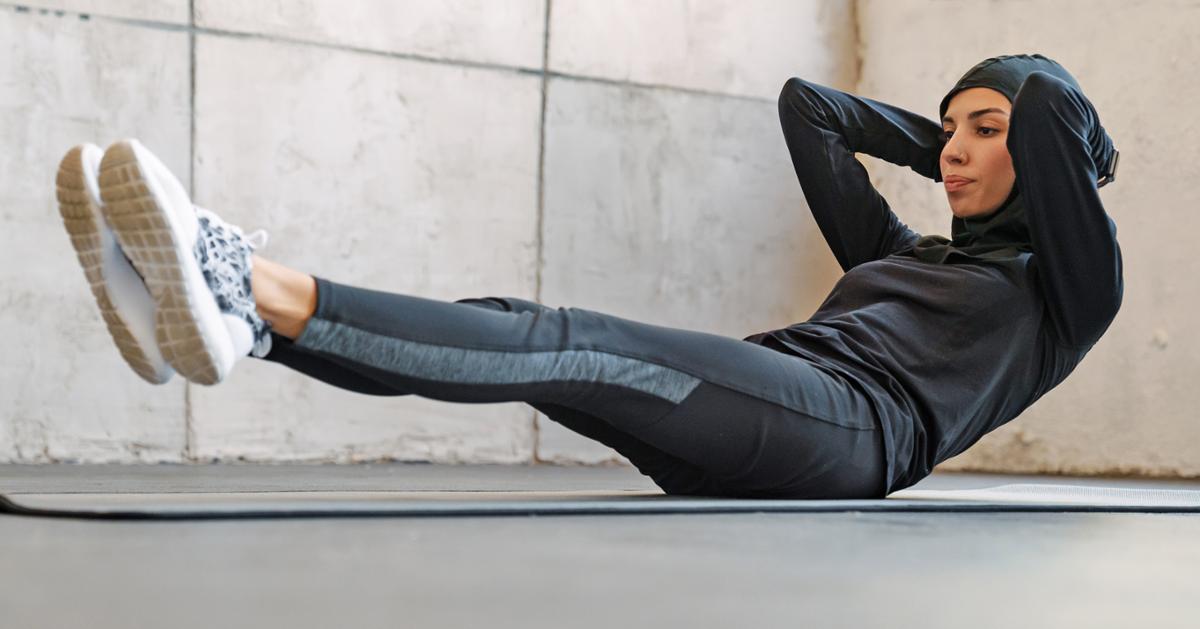
TikTok’s Shy Girl Workout, which has almost half a billion views and
counting, indicates females frequently have a different relationship to the gym from men. Kath Hudson reports on how the industry is responding
Young women are the most likely to receive unwanted male attention / Photo: shutterstock/Ground Picture
Women are still not exercising as much as men. Sport England’s latest Active Lives Adult Report showed the gender divide still exists, while Nuffield Health’s recent Healthier Nation Index revealed that women’s fitness levels are going in the wrong direction. Thirty one per cent of the women questioned felt their fitness levels had improved in the last year, but 33 per cent considered themselves less fit. By comparison, 38 per cent of men said they felt fitter in the last year, versus 26 per cent feeling less fit.
Sport England’s This Girl Can campaign found that women experience an “enjoyment gap” compared to men when it comes to physical activity. Some of this comes down to safety: a 2022 survey found that 53 per cent of women reported safety concerns while working out in non-supervised public facilities and 19 per cent in supervised public facilities – which suggests the trend towards staffless clubs will not appeal to half of women.
Research from UK Active and This Girl Can found while only 5 per cent of female gym users reported feeling unsafe in relation to sexual harassment and intimidation within facilities, 42 per cent of women surveyed had experienced some form of sexual harassment or intimidation in their fitness or leisure centre, such as inappropriate comments, staring, or encroachment of personal space. This increases to 83 per cent for those aged 16 to 24.
Sixty eight per cent never reported it, either because they didn’t know who to report it to, or didn’t think it was serious enough. However, 76 per cent changed their behaviour as a result, either changing the time they visited facilities, or the way they dressed.
Fifty five per cent of women said it was unclear how to report sexual harassment or intimidation at their fitness or leisure centre.
Safer Spaces UK Active and Sport England’s This Girl Can team are looking to tackle this with the two-year project, Safer Spaces to Move, which looks to understand the barriers women can face when taking part in physical activity at fitness and leisure facilities. To date, it has produced guides to provide tangible advice and best practice guidance and has created the Safer Spaces to Move Taskforce, as well as The Safer Spaces to Move Hub, which is intended to be a one-stop shop for fitness professionals to learn, upskill and keep up to date with the latest progress, research findings and resources.
One initiative the taskforce ran this year was the Ask for Angela pilot, in London. This nationally-recognised safety campaign was originally designed for licensed venues. People who feel like they are in an unsafe situation ask staff for help by discreetly using the code word “Angela”.
Staff at each of the 11 participating facilities – operated by Anytime Fitness and Lampton Leisure – were provided with a range of training tools, including a training handbook, and an animated training video developed for the sector, that included advice and information on what behaviour might constitute sexual harassment and intimidation in a gym setting; how to respond when a customer Asks for Angela; when to escalate a matter to senior management and how to embed Ask for Angela alongside existing policies.
Head of campaign activation at This Girl Can, Claire Edwards, said: “Ask for Angela reassures women and girls that they can, and should, seek help or report any situation that has left them feeling uncomfortable and that staff will be on hand to help. The campaign has a proven history in the hospitality sector and we’re confident it will be beneficial to the health and fitness industry.”
Upskill staff Women’s bodies are very different from men’s: they go through many different life stages and for menstruating women they can change from one day to the next. Another way gyms can help tackle gymtimidation is by upskilling staff so they are experts in female physiology and then use this expertise as a USP, so women who wouldn’t normally set foot inside the gym might think it is for them.
The Well HQ is doing great work to raise awareness of women’s physiology, having worked with Adidas to create a free course about menstruation. The Gym Group has been an early adopter and is currently working with The Well HQ to train staff on how to support women who are in mid-life.
Women’s only areas Total Fitness has tackled gymtimidation head on by opening a dedicated gym for women at its club in Whitefield, with a second site about to open. CEO, Sophie Lawler, said: “We listened to thousands of women through our research and have applied what we learned in a very thoughtful way to create a gym that’s designed to help them feel at ease while working out. It’s a space where women can achieve progression and enjoy a full, uninterrupted workout, no matter the occasion, their frame of mind or life stage.”
Urban Gym Group is piloting female zones in some clubs and will conduct a survey to see whether the female members experience better workouts, before deciding whether to roll out more across the estate.
“Women appreciate a place in which they can work out without a stare or comments,” says CEO, Neil Randall. “It is not just about creating a safe space for women – we prioritise this in the entire gym – but making sure the offering tailors the majority of our female members’ needs, such as enough room to do your squats, deadlifts and bench presses, with assistance of female instructors who have a deep understanding of the power of strength training on our physique and mental health.”
It’s heartening to see the barriers for women are being recognised and tackled. Going forward it will be interesting to see whether more operators create women-only zones, sessions, or even gyms, and whether we will see more women in leadership positions.
The UK spa review and discovery platform for consumers, the Good Spa Guide, has announced
it will host the Good Spa Guide Awards 2026 during an event on 16 November at Sopwell House
Hotel in St Albans, UK.
Eighty-four per cent of consumers now say wellness is a top priority in their lives, with this
percentage increasing year on year, according to a preview presentation of McKinsey’s Future of
Wellness 2026 research report.
Mass protests have been taking place since Monday 1 June in Albania over the development of
a luxury resort by Donald Trump’s daughter Ivanka Trump and her husband Jared Kushner.
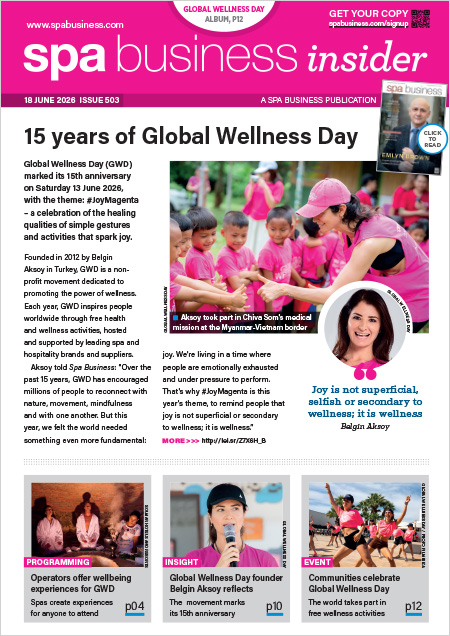
Global Wellness Day (GWD) marked its 15th anniversary on Saturday 13 June 2026, with the
theme: #JoyMagenta – a celebration of the healing qualities of simple gestures and activities
that spark joy.
Global luxury hospitality brand, Six Senses, has partnered with longevity healthcare provider,
HUM2N, to launch a clinic at Six Senses London, at The Whiteley.
As part of its first hotel partnership, Mayrlife – the medical health resort company known for its
site in Altaussee, Austria – has launched a day clinic at the Rosewood Vienna.
Premium London health club, KX Chelsea, will imminently unveil its most significant
redevelopment since its launch in 2002 to create an integrated wellness model combining
training, recovery and relaxation.
Rosewood Le Guanahani St Barth, on the northeast coast of Saint Barthélemy in the French
West Indies, is offering a programme of ocean-inspired yoga classes between 8-14 June to
celebrate Global Wellness Day (GWD).
Hotel de France, located on the British Isle of Jersey, has created a wellness retreat package
that includes a hot yoga session that will take place in Jersey Zoo’s butterfly sanctuary.
The Ritz-Carlton, Langkawi, in Malaysia, has revealed a schedule for Global Wellness Day
(GWD) that includes guided rainforest walks, mindful movement and guided coastal meditation
experiences.
+ More news
COMPANY PROFILES
Bellezi Founded in 2009 as a Dutch family business, Bellezi brings more than 20 years of experience in treat [more...]