International SPA Association - iSPA
 
EMPLOYERS: POST A JOB
Free ezines & magazines
News Video Training Products Magazines Spa Business spa-kit Handbook What's on Advertise Subscribe
Catalogue gallery
More catalogues
Diary dates
Powered by leisurediary.com
09-11 Jun 2026
Savutuvan Apaja, Haapaniemi, Finland
09-12 Jun 2026
Hotel Cascais Miragem Health & Spa, Portugal
21-23 Jun 2026
Midlands (Venue TBA), Liphook, United Kingdom
22-22 Jun 2026
Worldwide,
03-05 Jul 2026
Copenhagen, Copenhagen, Denmark
19-21 Jul 2026
The Global Ambassador , Phoenix, United States
22-25 Jul 2026
The Global Ambassador , Phoenix, United States
23-26 Aug 2026
The Riviera Maya Edition Kanai, Playa del Carmen, Mexico
WHO: Life expectancy increased by five years since 2000, but health inequalities persist
By Jane Kitchen 23 May 2016
Life expectancy increased by five years between 2000 and 2015, the fastest increase since the 1960s Credit: Shutterstock/ 274991978
Dramatic gains in life expectancy have been made globally since 2000, but major inequalities persist within and among countries, according to this year’s “World Health Statistics: Monitoring Health for the SDGs,” a report compiled by the World Health Organization.

Life expectancy increased by five years between 2000 and 2015, the fastest increase since the 1960s. Those gains reverse declines during the 1990s, when life expectancy fell in Africa because of the AIDS epidemic and in Eastern Europe following the collapse of the Soviet Union.

The increase was greatest in the African Region of WHO, where life expectancy increased by 9.4 years to 60 years, driven mainly by improvements in child survival, progress in malaria control and expanded access to antiretrovirals for treatment of HIV.

“The world has made great strides in reducing the needless suffering and premature deaths that arise from preventable and treatable diseases,” said Dr Margaret Chan, director-general of WHO. “But the gains have been uneven. Supporting countries to move towards universal health coverage based on strong primary care is the best thing we can do to make sure no one is left behind.”

Global life expectancy for children born in 2015 was 71.4 years (73.8 years for females and 69.1 years for males), but an individual child’s outlook depends on where he or she is born. The report shows that newborns in 29 countries – all of them high-income – have an average life expectancy of 80 years or more, while newborns in 22 others – all of them in sub-Saharan Africa – have life expectancy of less than 60 years.

With an average lifespan of 86.8 years, women in Japan can expect to live the longest. Switzerland enjoys the longest average survival for men, at 81.3 years. People in Sierra Leone have the world’s lowest life-expectancy for both sexes: 50.8 years for women and 49.3 years for men.

Healthy life expectancy, a measure of the number of years of good health that a newborn in 2015 can expect, stands at 63.1 years globally (64.6 years
for females and 61.5 years for males).

This year’s World Health Statistics brings together the most recent data on the health-related targets within the Sustainable Development Goals (SDGs) adopted by the United Nations General Assembly in September 2015.

While the Millennium Development Goals focused on a narrow set of disease-specific health targets for 2015, the SDGs look to 2030 and are far broader in scope.

For example, the SDGs include a broad health goal, “Ensure healthy lives and promote well-being for all at all ages,” and call for achieving universal health coverage.

This year’s “World Health Statistics” shows that many countries are still far from universal health coverage as measured by an index of access to 16 essential services, especially in the African and eastern Mediterranean regions. Furthermore, a significant number of people who use services face catastrophic health expenses, defined as out-of-pocket health costs that exceed 25 per cent of total household spending.

The report includes data that illustrate inequalities in access to health services within countries – between a given country’s poorest residents and the national average for a set of reproductive, maternal and child health services. Among a limited number of countries with recent data, Costa Rica, Jordan, Maldives, Mongolia, Swaziland, Thailand, and Uzbekistan lead their respective regions in having the most equal access to services for reproductive, maternal, newborn and child health.

The “World Health Statistics 2016” provides a comprehensive overview of the latest annual data in relation to the health-related targets in the SDGs, illustrating the scale of the challenge. Every year:

• 303,000 women die due to complications of pregnancy and childbirth;
• 5.9 million children die before their fifth birthday;
• 2 million people are newly infected with HIV, and there are 9.6 million new TB cases and 214 million malaria cases;
• 1.7 billion people need treatment for neglected tropical diseases;
more than 10 million people die before the age of 70 due to cardiovascular diseases and cancer;
• 800,000 people commit suicide;
• 1.25 million people die from road traffic injuries;
• 4.3 million people die due to air pollution caused by cooking fuels;
• 3 million people die due to outdoor pollution; and
• 475,000 people are murdered, 80 per cent of them men.
Addressing those challenges will not be achieved without tackling the risk factors that contribute to disease. Around the world today:
• 1.1 billion people smoke tobacco
• 156 million children under 5 are stunted, and 42 million children under 5 are overweight
• 1.8 billion people drink contaminated water, and 946 million people defecate in the open
• 3.1 billion people rely primarily on polluting fuels for cooking


News
1 to 12 of 9473 news stories
08 Jun 2026
Longevitix, a clinical platform for preventive and longevity medicine, has launched its AI-powered intelligence system to help physicians deliver continuous, personalised longevity-focused care at scale. Longevitix combines years of scattered patient data into a complete ... More
07 Jun 2026
Luxury wellness resort, The Retreat Costa Rica, has introduced its Vida Mía Longevity Centre at the property’s Vida Mía Healing Centre and Spa.  The longevity centre adds physician-guided programming to the resort, which was founded ... More
08 Jun 2026
Atmantan Wellness Centre, an integrative wellness destination in Mulshi, near Pune in India, is expanding its portfolio by adding a new centre in Hyderabad that will launch between 2028 and 2029. Atmantan is a retreat ... More
10 Jun 2026
Rosewood Le Guanahani St Barth, on the northeast coast of Saint Barthélemy in the French West Indies, is offering a programme of ocean-inspired yoga classes between 8-14 June to celebrate Global Wellness Day (GWD). GWD ... More
09 Jun 2026
The Ritz-Carlton, Langkawi, in Malaysia, has revealed a schedule for Global Wellness Day (GWD) that includes guided rainforest walks, mindful movement and guided coastal meditation experiences. Founded in 2012 by Belgin Aksoy in Turkey, GWD ... More
05 Jun 2026
Mexican operator, Solmar Hotels and Resorts, is hosting a series of events in celebration of Global Wellness Day, including a Temazcal ceremony at its Playa Grande Resort and Spa in Los Cabos. The not-for-profit movement, ... More
12 Jun 2026
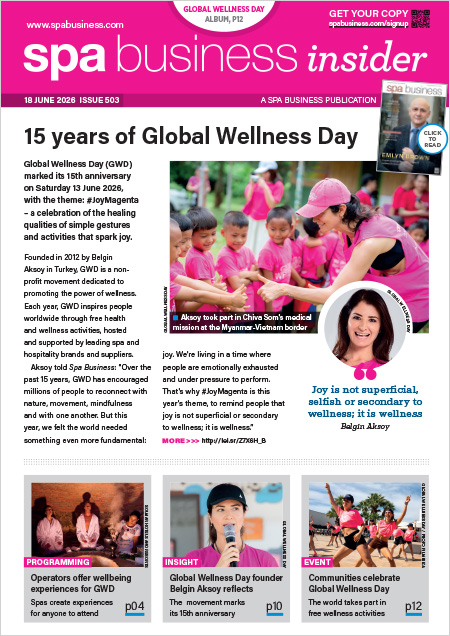
Global Wellness Day (GWD) will mark its 15th anniversary on Saturday 13 June 2026, with the theme: #JoyMagenta – a celebration of the healing qualities of simple gestures and activities that spark joy. Founded in ... More
03 Jun 2026
Four Seasons Resort The Nam Hai in Hoi An, Vietnam, has put together a Global Wellness Day (GWD) agenda with activations rooted in nature and shaped by four pillars of Joy – in alignment with ... More
01 Jun 2026
Rainer Maelzer, an experiential entertainment innovator, has been appointed chief entertainment officer by Therme Group.  With decades of experience in immersive water-based attractions, Maelzer will lead the development and global delivery of the company’s recreational ... More
03 Jun 2026
Lithuanian care operator Addere Care has launched a “wellness care hospital” in Vilnius. It's the company’s second Lithuanian site, following a hospital in Trakai, but the first to offer professional medical care in a spa ... More
28 May 2026
Auko, an all-inclusive development, is opening in Phong Nha in Vietnam in Q3 2026, with a series of 30 tented eco-lodges and wellness hospitality operations by Lumina Wellbeing. Van Phu Real Estate Development JSC owns ... More
05 Jun 2026
A recent survey by the UK Spa Association (UKSA) into the industry’s approach to cancer care has revealed that almost half of participating respondents (46 per cent) are unaware that cancer is a disability and ... More
     
International SPA Association - iSPA
The Leisure Media Company Ltd
Company Profile
Unbescheiden GmbH
Unbescheiden GmbH was founded in 1869 in Baden- Baden, Germany [more]
 
MORE PROFILES
Featured Supplier
Introducing Glass Act by Templespa
Introducing Glass Act, your new go-to eye serum for brighter, smoother, beautifully awakened eyes. ... more
Lemi
Product news
Rebalance Tech ramps up Impulse rollout
Voya launches Resurge Hair and Scalp Elixir and spa treatments
Nilo Spa Design introduces Marea dry flotation bed
Esse Skincare upgrades Probiotic Serum with fourth live probiotic species
Sweet Bee Organics enters spa market at The Ned London with magnesium-infused treatment
Templespa releases brightening Glass Act eye serum
Directory

 
JOBS
NEWS
VIDEO
TRAINING
PRODUCTS
MAGAZINE
 
SPA BUSINESS
SPA-KIT.NET
SPA BUSINESS HANDBOOK
SUBSCRIBE
ADVERTISE
FREE DIGITAL SUBSCRIPTIONS
CONTACT US

Leisure Media
Tel: +44 (0)1462 431385

©Cybertrek 2026


International SPA Association - iSPA
News   Products   Magazine
NEWS
WHO: Life expectancy increased by five years since 2000, but health inequalities persist
POSTED 23 May 2016 . BY Jane Kitchen
Life expectancy increased by five years between 2000 and 2015, the fastest increase since the 1960s Credit: Shutterstock/ 274991978
Dramatic gains in life expectancy have been made globally since 2000, but major inequalities persist within and among countries, according to this year’s “World Health Statistics: Monitoring Health for the SDGs,” a report compiled by the World Health Organization.

Life expectancy increased by five years between 2000 and 2015, the fastest increase since the 1960s. Those gains reverse declines during the 1990s, when life expectancy fell in Africa because of the AIDS epidemic and in Eastern Europe following the collapse of the Soviet Union.

The increase was greatest in the African Region of WHO, where life expectancy increased by 9.4 years to 60 years, driven mainly by improvements in child survival, progress in malaria control and expanded access to antiretrovirals for treatment of HIV.

“The world has made great strides in reducing the needless suffering and premature deaths that arise from preventable and treatable diseases,” said Dr Margaret Chan, director-general of WHO. “But the gains have been uneven. Supporting countries to move towards universal health coverage based on strong primary care is the best thing we can do to make sure no one is left behind.”

Global life expectancy for children born in 2015 was 71.4 years (73.8 years for females and 69.1 years for males), but an individual child’s outlook depends on where he or she is born. The report shows that newborns in 29 countries – all of them high-income – have an average life expectancy of 80 years or more, while newborns in 22 others – all of them in sub-Saharan Africa – have life expectancy of less than 60 years.

With an average lifespan of 86.8 years, women in Japan can expect to live the longest. Switzerland enjoys the longest average survival for men, at 81.3 years. People in Sierra Leone have the world’s lowest life-expectancy for both sexes: 50.8 years for women and 49.3 years for men.

Healthy life expectancy, a measure of the number of years of good health that a newborn in 2015 can expect, stands at 63.1 years globally (64.6 years
for females and 61.5 years for males).

This year’s World Health Statistics brings together the most recent data on the health-related targets within the Sustainable Development Goals (SDGs) adopted by the United Nations General Assembly in September 2015.

While the Millennium Development Goals focused on a narrow set of disease-specific health targets for 2015, the SDGs look to 2030 and are far broader in scope.

For example, the SDGs include a broad health goal, “Ensure healthy lives and promote well-being for all at all ages,” and call for achieving universal health coverage.

This year’s “World Health Statistics” shows that many countries are still far from universal health coverage as measured by an index of access to 16 essential services, especially in the African and eastern Mediterranean regions. Furthermore, a significant number of people who use services face catastrophic health expenses, defined as out-of-pocket health costs that exceed 25 per cent of total household spending.

The report includes data that illustrate inequalities in access to health services within countries – between a given country’s poorest residents and the national average for a set of reproductive, maternal and child health services. Among a limited number of countries with recent data, Costa Rica, Jordan, Maldives, Mongolia, Swaziland, Thailand, and Uzbekistan lead their respective regions in having the most equal access to services for reproductive, maternal, newborn and child health.

The “World Health Statistics 2016” provides a comprehensive overview of the latest annual data in relation to the health-related targets in the SDGs, illustrating the scale of the challenge. Every year:

• 303,000 women die due to complications of pregnancy and childbirth;
• 5.9 million children die before their fifth birthday;
• 2 million people are newly infected with HIV, and there are 9.6 million new TB cases and 214 million malaria cases;
• 1.7 billion people need treatment for neglected tropical diseases;
more than 10 million people die before the age of 70 due to cardiovascular diseases and cancer;
• 800,000 people commit suicide;
• 1.25 million people die from road traffic injuries;
• 4.3 million people die due to air pollution caused by cooking fuels;
• 3 million people die due to outdoor pollution; and
• 475,000 people are murdered, 80 per cent of them men.
Addressing those challenges will not be achieved without tackling the risk factors that contribute to disease. Around the world today:
• 1.1 billion people smoke tobacco
• 156 million children under 5 are stunted, and 42 million children under 5 are overweight
• 1.8 billion people drink contaminated water, and 946 million people defecate in the open
• 3.1 billion people rely primarily on polluting fuels for cooking
RELATED STORIES
WHO: inaugural NCD report


Chronic illnesses such as cancer, heart disease and diabetes have reached global epidemic proportions and now cause more deaths than all other diseases combined, according to the World Health Organization (WHO).
MORE NEWS
The Retreat Costa Rica debuts Vida Mía Longevity Centre
Luxury wellness resort, The Retreat Costa Rica, has introduced its Vida Mía Longevity Centre at the property’s Vida Mía Healing Centre and Spa.
Almost half of spa survey respondents are unaware cancer is a disability and not adapting treatments is discrimination
A recent survey by the UK Spa Association (UKSA) into the industry’s approach to cancer care has revealed that almost half of participating respondents (46 per cent) are unaware that cancer is a disability and guests with a cancer diagnosis must be given
Solmar Hotels and Resorts offers Temazcal ceremony for Global Wellness Day
Mexican operator, Solmar Hotels and Resorts, is hosting a series of events in celebration of Global Wellness Day, including a Temazcal ceremony at its Playa Grande Resort and Spa in Los Cabos.
Mandarin Oriental announces standalone Mansions-branded residences for Abu Dhabi
Mandarin Oriental has announced a standalone residence brand, Mansions, which will debut at Emirates Palace, Mandarin Oriental Mansions, Abu Dhabi, in 2029.
Healing sanctuary Tulah Clinical Wellness opens in Kerala
Tulah Clinical Wellness, a holistic wellness destination, has officially opened in the hills of northern Kerala, India.
Four Seasons Resort The Nam Hai creates Global Wellness Day programme rooted in nature
Four Seasons Resort The Nam Hai in Hoi An, Vietnam, has put together a Global Wellness Day (GWD) agenda with activations rooted in nature and shaped by four pillars of Joy – in alignment with the day’s theme #JoyMagenta.
+ More news   
 
COMPANY PROFILES
Life Fitness/Hammer Strength

Life Fitness / Hammer Strength works with some of the world’s most recognised hospitality brands, su [more...]
+ More profiles  
DIRECTORY
+ More directory  
DIARY


09-11 Jun 2026

World Sauna Forum 2026

Savutuvan Apaja, Haapaniemi, Finland
09-12 Jun 2026

W3Spa EMEA

Hotel Cascais Miragem Health & Spa, Portugal
+ More diary  


CONTACT US

Leisure Media
Tel: +44 (0)1462 431385

©Cybertrek 2026

ABOUT LEISURE MEDIA
LEISURE MEDIA MAGAZINES
LEISURE MEDIA HANDBOOKS
LEISURE MEDIA WEBSITES
LEISURE MEDIA PRODUCT SEARCH
PRINT SUBSCRIPTIONS
FREE DIGITAL SUBSCRIPTIONS