In the fast-paced world of fitness and wellness, where high-intensity workouts push us to
our limits and the sweat pours, the importance of efficient recovery cannot be overstated. ... more
How do the salaries and benefits of therapists differ around the world? Lisa Starr analyses a survey of staff in 38 countries and gets some industry opinion on the findings
By Lisa Starr | Published in Spa Business Handbook 2014 issue 1
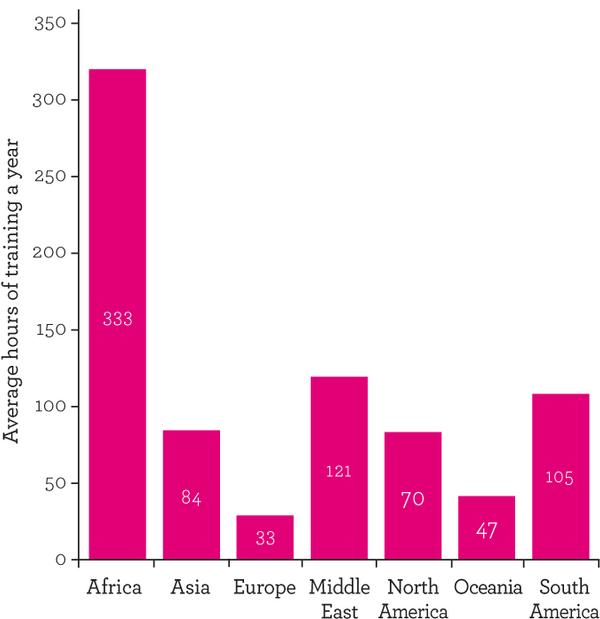
Graph 1: Average Hours of Therapist Training a Year by World Region
As consumers increasingly enjoy spa treatments while they travel, few probably realise how different the behind-the-scene set-up is. Spa therapy lacks globally recognised standards both for staff and facilities, which leads to widely varying abilities among therapists from one country to another, and even from spa to spa.
Disparities are particularly notable in terms of therapist pay despite the cost of living. What’s appropriate in terms of benefits differs too. Beyond providing minimum wages, employers in most countries aren’t required to offer any kind of benefit – even including paid-for time off.
This article highlights examples of therapist pay packages based on an informal survey (see p90) of a variety of spas in 38 countries. The survey isn't a scientific one. It's based only on approximate figures that may not be directly comparable to each other.
What it’s intended to do is give some kind of idea about what the global variations are in the industry and spark debate. If the sector wants to attract high-quality staff, should pay methods be more consistent, for example? What regions might lead the way on this and which ones need to improve?
Africa The spa industry is still in its infancy in Africa, although there are development hot spots such as South Africa and Morocco.
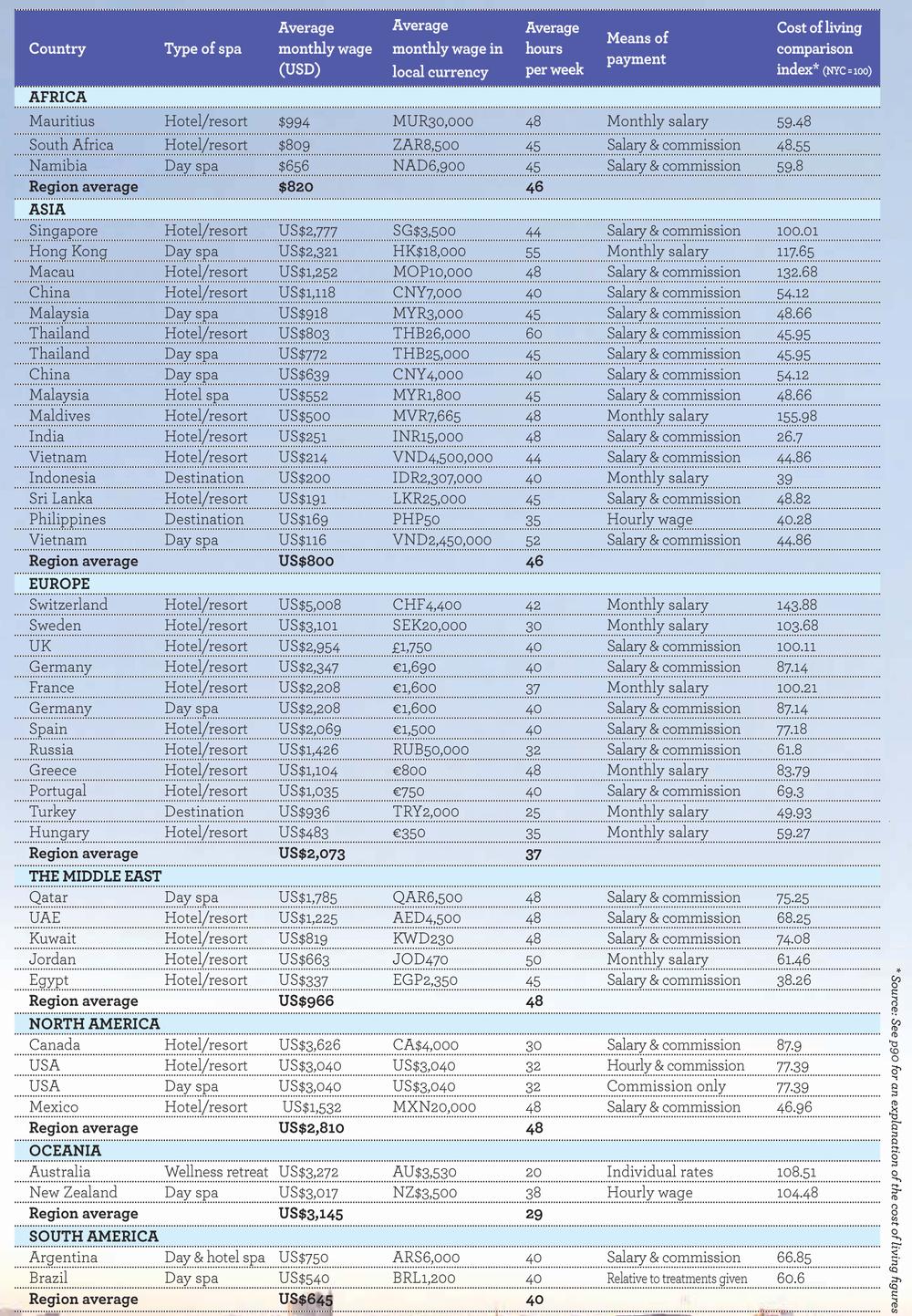
Estimated salaries in the survey range from US$656-US$994 and are the third lowest in the global samples even though the average working hours of 46 a week are among the highest (see Table 1). Verena Lasvigne-Fox, spa director at the Four Seasons in Marrakech, comments: “Salary developments in Africa will depend on the tourism industry in each particular area.” As tourism evolves there’ll be more demand for higher quality therapists which will lead to higher salaries.
She says that there’s also a changing trend in the way employees are paid: “Therapists here, or at least in northern Africa, have started orientating themselves on the European compensation models, and are asking for commission and incentives, as most spas still pay a flat salary.”
On the plus side, training hours are by far the highest. This survey classes training as a benefit because as well as helping employers, it's greatly valued by staff and provides them with lifelong skills. In the examples from Africa, therapists receive an average of 333 hours of training a year: over 200 hours more than the entries in any other region (see Graph 1). Lasvigne-Fox says: “Without regulation, beauty schools or standards, the bulk of the responsibility for training therapists falls onto the spas themselves.”
Asia Traditionally, therapists in Asia have always been at the lower end of the worldwide pay scale and survey findings corroborate this. The average monthly salary of the example spas in Asia is US$800, which is the second lowest of other average regional samples (just above Africa). This is in line with the cost of living which, with the exception of large cities and financial centres, is roughly half of that in Europe and North America.
However, it’s difficult to find consistencies in staff salaries and packages between countries and even cities. There’s a big jump from the worst paid therapists – those working in day spas in Vietnam who earn US$116 a month, to the best earners – namely hotel/resort therapists in Singapore who bring home US$2,777 a month. Similarly, the working week ranges from 35 hours in the example spa from Philippines and goes up to 60 hours in Thailand.
Samantha Foster, who’s been a spa consultant in the region for more than 20 years, has noticed that despite disparities, all salaries are increasing. “To date, Asia has enjoyed relatively low labour costs," she says, "which has enabled high staff-to-guest ratios and resulted in the region’s excellent reputation for service. But salaries are rising faster than [spa] revenue in many countries.”
She feels there’s a need for change in the industry. “We should start looking at more creative approaches to staffing now, while we still have the advantage. Practices such as cross-training, job-sharing and greater use of part-time, casual and contract labour can help operators keep fixed costs under control while making the operation more flexible. These practices are not well known in Asia and in certain cases labour law or logistics (such as at remote resort locations) may not permit it, but it's worth starting to explore the idea in principle.”
Europe Europe offers a multitude of spa models, from mineral spas, hot spring resorts and medical clinics to hotel and day spas. This undoubtedly leads to imbalances: even though only three types of spas were represented in the survey, therapists in the example spas in this region still had the widest range of salaries. Earnings are as low as US$483 a month in Hungary but as high as US$5,008 in Switzerland – nearly US$2,000 a month more than therapists from Sweden who are the second best paid in the European example spas. Differences aren't so obvious with pay structures – there seems to be an even split between therapists who earn a flat wage and a wage plus commission. An average working week is 37 hours.
Anna Bjurstam, who owns the Raison d’Etre spa consultancy based in Sweden says: “In Europe, there are so many countries with fundamentally different constitutions that this greatly affects the costs and challenges of employment. Many countries are still suffering under the financial crisis, but their different handling of the situation creates great variances.”
Bjurstam, who’s also the vice-president of global spa and wellness for management company Six Senses, adds: “Where there are low salaries in Europe, it’s reflective of spending power in that country. You can feel fortunate to reach a 20 per cent profit margin in spas [because consumer purchasing is down]. These macroeconomic factors are beyond the control of the spa industry, but operators need to plan accordingly.”
Positioning spas to attract a new audience could be a solution she says: “In third world countries with a wellness tourism component, such as Indonesia and Thailand, salaries are low but spending is high, which creates profitable spas.”
Jean-Guy de Gabriac, founder of French training company Tip Touch International, contributes: “As with everywhere, employers claim they pay too much while therapists argue that a low pay is not motivating, hence causing high turnover [of employees].”
That said, therapists in the examples from Europe do actually have the third highest average income out of the global sample at US$2,073 a month, behind those in Oceania and North America. Where they seem to fare the worst is education. According to the survey, therapists in the region have the least amount of training – only 33 hours a year on average – out of the global sample.
Middle East The data provided by survey respondents in the Middle East shows great variances in pay rates (although not as much as in Europe). Monthly salaries range from US$337 a month in Egyptian hotel/resort spas – the lowest average out of the samples by nearly US$300 – and go up to US$1,785 for therapists in day spas in Qatar.
Methods of pay and hours are more consistent. Therapists earn commission and a base salary in every entry except for Jordan, the survey showed. Working hours range only from 45-50 a week, yet are some of the highest out of all the global spa examples.
Kathryn Moore is the international project manager for MSpa which has five facilities in the Middle East. She says that as there’s a lack of home-grown talent, therapists are brought in from abroad which is one reason for varying wages. It also means employers are obliged to offer better benefits – therapists in the region get everything from full health insurance and housing allowances to yearly bonuses and paid time off.
“Almost all therapists in the Middle East come from other countries,” says Moore. “Originally they were just from Thailand or Bali, but recently the net has widened. We’re finding that therapists from South Africa, Australia and the UK are willing to work for the same amount as Asian therapists and have more ability to drive sales and bring in much more revenue.”
Yet while staff from more developed countries are better at retailing – bringing gross profits more in line with those in the US, UK and Australia – Moore believes this will eventually push up the cost of labour.
On average, the survey examples show that staff in the Middle East received 121 hours of training a year which is the second highest out of all samples. This is likely to be a result of the extra education that’s required to work in Muslim cultures, as well as high-service standards demanded by guests in the many five- and six-star resort properties.
North America Therapist salaries reported in North America were among the highest in the survey. At a regional average of US$2,810 a month, pay was second only to that in Oceania.
There are a number of reasons why staff might get paid more in this region. There’s no one governing body or norm for therapist licensing across the US and Canada which, along with the high demand for workers, gives more power to employees who can push for higher salaries.
What’s more, while both countries have standard minimum wages, therapists are easily able to exceed these requirements due to pay methods. In most parts of the world, beauty therapists get a monthly salary and sometimes commission from retail. In North America, however, therapists also earn commission on treatments too. In the US, it’s common for therapists in day spas – which make up three quarters of the country’s spa facilities – to receive no base salary and earn all of their income as a commission on the treatments they provide.
Commission is often up to 50 per cent of the retail price of the treatment, so therapists can pass the minimum wage after only two or three appointments. Unsurprisingly, they work shorter weeks – in the examples, the average working week was only 36 hours.
It's not all good news, however, as benefit packages are generally poor. Most US spas are owner-operated and until Obama's recent Affordable Care Act, they didn't offer either healthcare or paid vacation time.
It’s also worth noting that as there’s no standard payment method, salaries can get creative. Rather than paying a straight percentage for all therapists, for example, operators can offer more compensation to those who reach set benchmarks – such as better client retention rates and average customer spend – that help drive business. Alternatively, they can vary compensation according to services: paying less for treatments where a high amount has been spent on pieces of equipment, for example, to get a quicker return on investment.
At first glance, the amount of training in North American examples might not seem high. There’s an average of 70 hours of education a year, which is less than those reported in entries for Africa, the Middle East, South America and Asia.
However, as the market is tightly regulated, Canadian and American therapists need to have anywhere between 300-1,500 hours worth of training before they can even earn a license to work. Because of this sound base knowledge, less emphasis is placed on extra education and training. As such, spas tend to focus on supplementary subjects such as sales, customer service and brand orientation.
Oceania In the examples given, therapists in New Zealand and Australia have wages that are comparable to those reported in US and the UK. They also have the highest regional average salaries out of the survey samples (US$3,145 a month) as well as the shortest working week (29 hours) and very generous employee benefits.
This can be explained by stringent labour laws. Hady Wenham, owner of the Forme Spa chain in New Zealand which consists of 10 spas, says: "Minimum wage in New Zealand is NZ$14.25 (US$12.32) an hour and in Australia it’s AU$16.37 (US$15.35) an hour. In addition, in New Zealand, employers must pay four weeks annual leave, about 10 of statutory holiday and five days of sick leave by law.
“Spa employees in New Zealand and Australia are commonly paid by hourly rate. They're often eligible for additional commission and bonus payments that are reliant on achieving various sales performance measures, but the hourly rate makes up the bulk of the salary. Fragments of the industry that have moved to a commission only model or flat fee per service but this appears to be less common.”
At 47 hours, the average reported amount of coaching time for therapists a year is the second lowest out of the regional survey examples. Wenham says training varies greatly between employers, with most operators turning to external product suppliers for initial sessions.
South America In South America, the spa industry is robust in a few countries, such as Brazil and Argentina, and barely developed in others. Yet in the survey examples, the average for therapist salaries, at US$645, is the least overall. This is similar to the reports from Africa when cost of living is considered.
In an overall survey comparison, the length of the average working week in the examples given for South America (40 hours) and the amount of time spent on training (105 hours) fell in the middle ground.
Yet for Gustavo Albanesi, the owner of the Buddha Spa chain in Brazil, spas still suffer from a lack of regulatory training requirements which he feels has a negative effect on the quality of service. “Spas in Brazil offer less than 10 hours of [initial] training for therapists on average,” he says, adding that much more is offered at his 18 Buddha Spas. “Because of this, spas are unable to establish good quality, or standard protocols, which reflects negatively on the profession.”
Albanesi points out that even when there are standards, they're not always followed. By law, spas in Brazil must provide benefits such as paid holidays but he says many spas, and some therapists, don't want to pay the attendant taxes and fees so they create their own plans.
Important for growth The examples given in this survey highlight the many differences in therapist salaries, pay methods and benefits globally.
Given the growing demand for spa treatments around the world and the burgeoning wellness industry, conversations need to be had about fair pay and compensation and what needs to change so the industry can attract and keep more therapists.
A consistency in wage and benefit standards, at least regionally, would make the industry more appealing to workers who may otherwise choose more standardised professions such as healthcare. Keeping staff well-trained and satisfied in their jobs will also be key to the long-term health and continued growth of the industry.
Gathering data
In this non-scientific survey, conducted in March 2014, 64 spa operators gave approximate details of therapist pay in their country, rather than their own workplace. Figures weren’t based on a uniform reporting system so may not be directly comparable. In some countries, only one manager responded. Averages were used for multiple country answers.
Numbeo, a website that aggregates lifestyle measurements, was used to provide a cost of living comparison against New York City (NYC) which is valued at 100. If a city has a rank of 80, it’s 20 per cent less expensive than NYC, for example. Numbeo figures are based on major cities in the relative countries.
ABOUT THE AUTHOR
Business consultant, trainer and educator and overall curious person, Lisa Starr has been helping spa companies maximise their performance – in front and back of house operations – for 30 years. She is also the guest editor of The Weekender, the newsletter for the Global Spa & Wellness Summit email: [email protected] twitter: @StarrTalk
Longevitix, a clinical platform for preventive and longevity medicine, has launched its AI-
powered intelligence system to help physicians deliver continuous, personalised longevity-
focused care at scale.
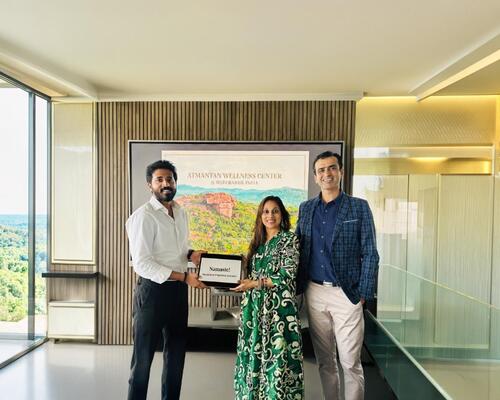
Atmantan Wellness Centre, an integrative wellness destination in Mulshi, near Pune in India, is
expanding its portfolio by adding a new centre in Hyderabad that will launch between 2028 and
2029.
A recent survey by the UK Spa Association (UKSA) into the industry’s approach to cancer care
has revealed that almost half of participating respondents (46 per cent) are unaware that
cancer is a disability and guests with a cancer diagnosis must be given
Mexican operator, Solmar Hotels and Resorts, is hosting a series of events in celebration of
Global Wellness Day, including a Temazcal ceremony at its Playa Grande Resort and Spa in Los
Cabos.
Mandarin Oriental has announced a standalone residence brand, Mansions, which will debut at
Emirates Palace, Mandarin Oriental Mansions, Abu Dhabi, in 2029.
Four Seasons Resort The Nam Hai in Hoi An, Vietnam, has put together a Global Wellness Day
(GWD) agenda with activations rooted in nature and shaped by four pillars of Joy – in
alignment with the day’s theme #JoyMagenta.
The Global Wellness Summit (GWS) will celebrate its 20th anniversary at the 2026 event in
Phuket, Thailand, later this year with the theme: The Science, Art and Soul of Wellness.
Auko, an all-inclusive development, is opening in Phong Nha in Vietnam in Q3 2026, with a
series of 30 tented eco-lodges and wellness hospitality operations by Lumina Wellbeing.
+ More news
COMPANY PROFILES
Templespa Templespa was founded in 2000 by Liz and Mark Warom, seasoned entrepreneurs with a proven track reco [more...]