‘‘Authentically Disney but distinctly Chinese.” That’s been the Disney line since the company announced plans to build a park and resort complex just outside the world’s third most populated city.
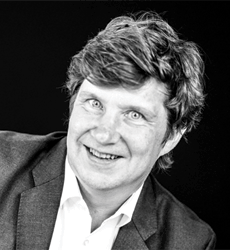
“We’re being careful to make the right statements in terms of not only being welcomed in China but also being correct culturally, instead of the opposite,” said Disney CEO Bob Iger, who’s overseen the development of the $5.5bn (£3.7bn, €4.9bn) destination.
Situated in Pudong in a specially designated tourism zone, Shanghai Disney Resort has five themed lands, two hotels, a retail and entertainment district and a metro station capable of delivering 20,000 people per hour to its door.
Iger has been involved in the project since the late 1990s, when then-chief Michael Eisner sent him looking for a site for the resort. Shanghai’s government earmarked the Pudong location, but did not officially approve the project until 2009. Shanghai Disney Resort – a collaboration between the state-owned Shanghai Shendi Group, with 57 per cent ownership, and the Walt Disney Company (43 per cent) – has been a long time coming.
Now, Iger is looking at an income qualified audience within a three-and-a-half hour travel radius – be that by metro, bus, high-speed rail or car – of more than 300 million people.
“It would be as though the whole population of the United States could afford a ticket to Orlando and could get there within three-and-a-half hours,” said Iger.
The potential audience, coupled with the scale of the destination – not to mention the combination of established and newly created IPs, tried-and-tested and brand new park experiences, Chinese and global culture – makes the opening of the Shanghai resort a watershed moment for Disney, for China and for the global attractions industry.
“After 17 years of working on this project, I’m still awed by it. The scale, the detail, the sheer artistry; it’s all breathtaking,” Iger said. “Even though it has all of the Disney details, it’s unlike any other destination we’ve ever created. We set out to build something truly extraordinary and we’ve succeeded in a way that far exceeds our most ambitious expectations.”
|
|
|