Joel Beckerman is a composer, producer, and founder of Man Made Music, a sonic branding studio, and author of The Sonic Boom: How Sound Transforms the Way We Think, Feel and Buy.
Gordon Grice is an architect, writer, editor, illustrator, and creative director at FORREC, based in Toronto, Canada.
Scott A Lukas is a researcher, anthropologist, YouTube documentarian, former theme park trainer, and author, who specialises in immersive worlds, theming and cultural remaking.
Most of us are happy to be just looking and listening. You might be reading this article on a train, with your earbuds in, or on the beach, comforted by the sound of waves, or in a café with soft music playing in the background. But in every case, important sensory information has not been accounted for. What about the bump-bump-bump and abrupt swaying of the carriage, the feeling of warm sun on your back, the aroma and taste of strong coffee? It takes all of these sensations to make up a complete experience.
This is why, as designers, we spend time tasting, smelling, touching, listening, looking – and observing. We want the environments we create to be complete environments.
Follow the nose
We have probably all had Marcel Proust moments, when we encounter an unexpectedly familiar aroma that suddenly transports us back to another time and place. Pretty soon, associated visual and aural memories also appear, creating an experience that can be strongly emotional. When we design entertainment environments, we are really trying to accomplish the same thing: to provide a memorable emotional experience by removing visitors from the here and now and transporting them to another time and place, with the aid of sensory design elements.
Given how efficient it is, why isn’t olfactory stimulus used all the time? The main reason is that stimuli don’t affect everybody in the same way. Smell memory is personal, as well as regional and cultural; an aroma that appeals to some people might easily disgust other people. It’s easy to miscalculate.
When we use smells as a design tool, we’re not trying to create everyone’s favourite aroma; we’re trying to complete or reinforce a sensory experience. The main objective is to get all of the senses working together in the same direction. By providing an aromatic element, we are adding an emotional connection and an element of memorability, reinforcing the visual, the auditory and the tactile, to create a total experience and to enhance what some have called “environmental authenticity”.
Stay in touch
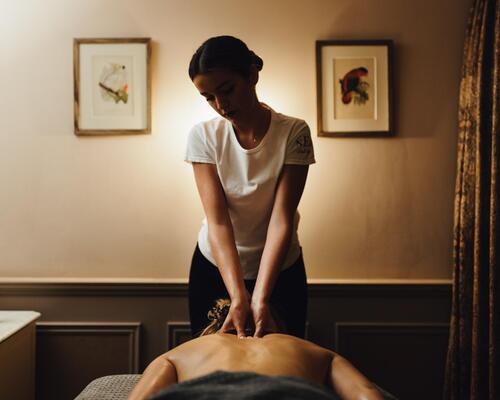
The other sense with a large emotional component is the sense of touch – more accurately, the somatosensory system. We sometimes say we are “touched” by something, when it stirs our emotions.
There are several reasons for this tactile-emotional connection. First, our other senses deal with discrete, measurable things, such as sound and light waves and airborne molecules, but our sense of touch connects us directly to our environment and involves the whole body. A second emotional connection occurs because our brain has two pathways for processing touch information: a sensory pathway that gives us the facts of the encounter – texture, temperature, pressure – and a social-emotional neural pathway that draws on our sense memory to tell us how we should “feel” about what we feel. A third reason, of special importance to entertainment designers, is that our sense of touch doesn’t only connect us to the outside world, it also monitors what is going on inside our bodies. This inner sense of touch is called proprioception. It’s the mechanism that sets off alarms when we lose equilibrium or orientation, for example, when we reach the top of a coaster lift and start to hurtle downwards.
Looks are everything
The visual sense is often the first of the senses that a guest experiences when entering a space. Amusement parks, since the days of Coney Island and Luna Park, have relied on dramatic visual stimuli to establish the foundations of a space.
The “look” of a space – whether approached through sightlines, colour, texture, depth, montage, juxtaposition, etc – allows the guest to associate what is distinctive about the space with the brand, contexts or services that it provides. In some ways, we could say that visual stimuli may overwhelm a guest in terms of the senses. As a designer, imagine if your guests focus primarily on visual cues that you have created, thus minimising all of the other sensory designs that you have offered. Perhaps for this reason, we have witnessed an increased popularity of “dark restaurants”, venues where guests eat in total darkness, requiring them to rely on the senses of taste, smell and touch.
Matters of taste
There are five basic tastes that we recognise: sweet, sour, salt, bitter and umami (a savoury or meaty taste). Taste is closely connected to flavour, which draws heavily on the sense of smell.
Scientists who study taste often focus on the chemical issues of foods and other substances that we ingest, but for architects and designers, the concern, typically, is how taste may be used to create memorable and immersive experiences in combination with the other senses.
A clear challenge of such design relates to the subjective nature of the human sense of taste. One guest may really enjoy sweet foods, while another will have a different preference. Contemporary culinary spaces, like the three-Michelin star molecular gastronomy restaurant Alinea in Chicago, Illinois, combine taste “tricks” with other sensory experiences for guests. British chef and restaurateur Heston Blumenthal is similarly celebrated for a highly experimental approach – for example, creating a sense of theatre by cooking with liquid nitrogen at the table.
Taste is a challenging sense to deploy as it often relies on an immediate, localised experience. We can hear sounds from a distance, but the same is not true for taste.
Combining the Senses
We should note that the senses should never be considered in isolation. Designers and psychologists alike are aware of synesthesia, or the idea of one sense impacting and causing an effect in another of the senses. As we think about effective sensory design, we should try to leverage the power of one sense to impact another, with the overall effect being the greater immersion of the guest in the space.
People do not differentiate each of the sensory elements that they experience in a space. This is the challenge in terms of creating a holistic, immersive space in which each of the senses is integrated seamlessly for the guest.
There are architects who will argue that any intentional sensory stimulation, other than visual, is a betrayal of architectural principles. The visual sense is by far the most important and it is this sense that has guided architectural design and experience since its very beginnings. But an increasing number of architects, not all of them involved in entertainment design, feel that the neglect of sensory design is the neglect of the complete (user) experience.
|
|
|