The Leisure Media Company Ltd
 
EMPLOYERS: POST A JOB
Free ezines & magazines
News Video Training Products Magazines Spa Business spa-kit Handbook What's on Advertise Subscribe
Catalogue gallery
More catalogues
Diary dates
Powered by leisurediary.com
09-11 Jun 2026
Savutuvan Apaja, Haapaniemi, Finland
09-12 Jun 2026
Hotel Cascais Miragem Health & Spa, Portugal
21-23 Jun 2026
Midlands (Venue TBA), Liphook, United Kingdom
22-22 Jun 2026
Worldwide,
03-05 Jul 2026
Copenhagen, Copenhagen, Denmark
19-21 Jul 2026
The Global Ambassador , Phoenix, United States
22-25 Jul 2026
The Global Ambassador , Phoenix, United States
23-26 Aug 2026
The Riviera Maya Edition Kanai, Playa del Carmen, Mexico
Addressing social fallout at the heart of AAM's 2017 TrendsWatch report
By Tom Anstey 16 Mar 2017
The report addresses mass migration driven by a number of factors is the defining issue of this century Credit: a katz / Shutterstock.com
Closing the empathy deficit, the next horizon of civil rights and the rise of the intelligent machines are all trends that will affect cultural institutions in the coming years, according to the 2017 edition of the Center for the Future of Museums’ (CFM) annual TrendsWatch report.

Written by Elizabeth Merritt, the report from the American Alliance of Museums (AAM) identifies the major trends that will shape the way museums worldwide will handle affairs, do business and engage visitors.

A Mile in My Shoes: closing the empathy deficit

The empathy deficit, something previously discussed by former US President Barack Obama, covers the inability to put oneself in someone else's shoes.

“Researchers across the globe are documenting a decline in this crucial capacity at a time when we dearly need to foster mutual understanding,” says the report. “The good news is that just as we can rehabilitate physical injuries, we can retrain our psyches to strengthen weak empathic skills. Museums’ inherent strengths position them to be effective ‘empathy engines’ helping people to understand the ‘other’ and reinforcing social bonds.”

The growing empathy deficit, which according to research has declined by nearly half (48 per cent) over the last four decades, has been tied to a decline in social trust and a rise in discrimination, bullying and hate crimes.

“These developments are of particular concern in a time when we are experiencing a global wave of forced migration that leaves many displaced people vulnerable to xenophobia and discrimination,” says the study.

“Museums should create environments that foster conversations between strangers and meaningful encounters between people of different backgrounds. Museums should also measure and value their ability to teach empathy and other emotional skills, in addition to facts and reasoning. This strength is particularly important in communities suffering from stress and violence, and for audiences that include people in positions of power – be it parents, politicians, teachers, or police – for whom empathy is a critical skill.”

Let Justice Roll Down: the next horizon of civil rights

According to AAM, justice is being re-examined with a critical eye toward how existing structures create or perpetuate inequality. In a museum setting, this means that museums have the opportunity to reflect on how assumptions about power, security, and order are embedded in their own operations, while also helping society to navigate “the next horizon of civil rights”.

“Museums’ communities are being buffeted by the economic, cultural, and political fallout from current inequities in the justice system," says the report. "Increasingly, museums are being called on to play a role in addressing these tensions through serving as venues for dialogue, as places of healing, or by acting as advocates for social justice. Museums can help society re-examine the history and current practice of justice in the US. They can create exhibits and programming that respond to current and local events and shape the discussion of how to move forward.”

As the museum sector continues in its efforts to diversify its workforce, the report adds that it must also consider the potential effects of excluding anyone with a criminal background. It argues that aside from disadvantaging a population that needs employment, the move also impedes progress towards racial diversity, given disproportionate statistics for people from non-white backgrounds with criminal convictions in the US.

The Rise of the Intelligent Machine

With computers and technologies becoming ever-more complex, artificial intelligence offers museums tools to manage data, as well as new tools in a creative capacity.

AI can benefit society in a number of ways, with education right at the top of the list. As referenced in TrendsWatch, the Defense Advanced Research Project Agency's Educational Dominance programme is already using AI-powered digital tutors to speed up training of Navy recruits. There are downsides however, with Oxford University projecting that AI will contribute to the loss of up to 47 percent of US jobs over the next 20 years, many of them being professional jobs typically requiring advanced degrees.

“As AI becomes more effective and affordable, it will become part of the standard toolkit of museums seeking to enhance their business practices,” says the report. “Rather than displacing staff, AI can give smaller museums that can’t afford dedicated specialists access to AI-powered legal services, marketing, communications, and data analytics. Even exploiting the potential of AI itself will not necessarily require AI-specific expertise, as we develop plug-in applications for the technology.”

Reshaping the World: migration, refugees, and forced displacement

“Mass migration, driven by conflict, oppression, political upheaval, climate change, environmental disasters, and economic distress has been described as the defining issue of this century,” says the report, adding that these events reshape the lives of people who are displaced, sparking both the best and the worst of human behaviour.

For museums, it is suggested that they can use their influence to build bridges between established residents and newcomers – to ease fears, build trust, and find common ground.

“Addressing migration gives older cultural museums a way to connect their mission to current events and new community members,” it says, while warning of a potential negative backlash from some parties and urging proper training to handle such a situation.

“Serving a community that includes recent migrants and refugees may require museums to adapt their hiring and training. Understanding the difficulties of conflict and conflict resolution can require a skill set unfamiliar within traditional museum professions. Museums may adapt by hiring people from nontraditional backgrounds, developing new training, and giving representatives of migrant communities meaningful roles in determining how the museum serves their needs. Museum staff may also need training to deal productively with anti-immigrant attitudes directed at the community, visitors, or the museum itself.”

The report suggests combating fear and prejudice by using storytelling to build levels of empathy, countering negative press with their collections, telling the story of migration and the resulting evolution of local communities. It also states that museums should help refugees find jobs, which has a twofold effect of meeting immediate practical needs, while also helping to integrate them into the local community.

Failing Toward Success: the ascendance of agile design

“Failure is a necessary design process”, suggests the paper, which argues that in a time of rapid social, technological, and economic change, organisations must try new things in order to succeed, and such innovation requires a tolerance for risk. With many museum business models experiencing significant disruptions, TrendsWatch suggests that museums must become comfortable with positive failure, meaning they need encouragement, tools, and positive feedback to buck the “traditional of perfectionism that has characterised the sector”.

“Museums, as a sector, share a culture of perfection that places large bets on getting a product – whether an exhibit, programme, or building – right the first time,” it says.

“This culture is often rooted in traditional, hierarchical management structures that evolved in a time that valued authority and control over collaboration and creativity. Museums that decide to move away from dysfunctional perfectionism have to work consciously to change an organisational culture that discourages risk taking. A culture of continuous improvement can’t simply be isolated in a new department or grafted onto traditional structures – it requires fundamental shifts in a museum’s ethos, including new forms of leadership and management.”

To read the full report click here.


News
1 to 12 of 9470 news stories
10 Jun 2026
Rosewood Le Guanahani St Barth, on the northeast coast of Saint Barthélemy in the French West Indies, is offering a programme of ocean-inspired yoga classes between 8-14 June to celebrate Global Wellness Day (GWD). GWD ... More
09 Jun 2026
The Ritz-Carlton, Langkawi, in Malaysia, has revealed a schedule for Global Wellness Day (GWD) that includes guided rainforest walks, mindful movement and guided coastal meditation experiences. Founded in 2012 by Belgin Aksoy in Turkey, GWD ... More
05 Jun 2026
Mexican operator, Solmar Hotels and Resorts, is hosting a series of events in celebration of Global Wellness Day, including a Temazcal ceremony at its Playa Grande Resort and Spa in Los Cabos. The not-for-profit movement, ... More
12 Jun 2026
Global Wellness Day (GWD) will mark its 15th anniversary on Saturday 13 June 2026, with the theme: #JoyMagenta – a celebration of the healing qualities of simple gestures and activities that spark joy. Founded in ... More
03 Jun 2026
Four Seasons Resort The Nam Hai in Hoi An, Vietnam, has put together a Global Wellness Day (GWD) agenda with activations rooted in nature and shaped by four pillars of Joy – in alignment with ... More
01 Jun 2026
Rainer Maelzer, an experiential entertainment innovator, has been appointed chief entertainment officer by Therme Group.  With decades of experience in immersive water-based attractions, Maelzer will lead the development and global delivery of the company’s recreational ... More
03 Jun 2026
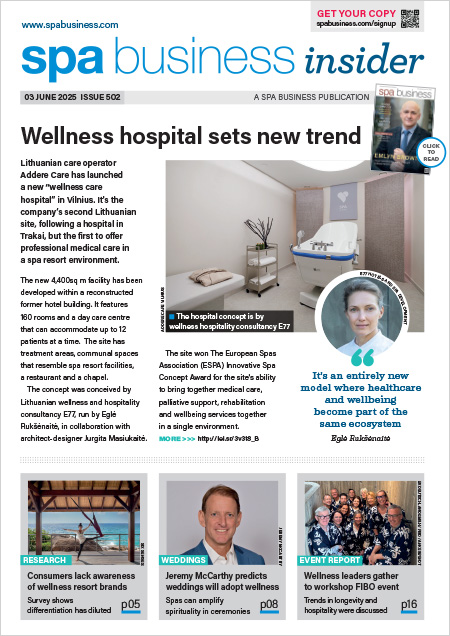
Lithuanian care operator Addere Care has launched a “wellness care hospital” in Vilnius. It's the company’s second Lithuanian site, following a hospital in Trakai, but the first to offer professional medical care in a spa ... More
28 May 2026
Auko, an all-inclusive development, is opening in Phong Nha in Vietnam in Q3 2026, with a series of 30 tented eco-lodges and wellness hospitality operations by Lumina Wellbeing. Van Phu Real Estate Development JSC owns ... More
05 Jun 2026
A recent survey by the UK Spa Association (UKSA) into the industry’s approach to cancer care has revealed that almost half of participating respondents (46 per cent) are unaware that cancer is a disability and ... More
26 May 2026
Wellness and hospitality thought leaders gathered recently for a workshop at Yasuragi, the Japanese spa and conference hotel near Stockholm. The purpose was to shape the FIBO Longevity and Hospitality Summit, which will happen in ... More
27 May 2026
LVMH-owned beauty house Guerlain will launch up to five spas with partners a year as part of its plan to expand globally, according to the brand’s international spa and wellness director, Diane Davody. In an ... More
27 May 2026
A new global study by Kevin Kelly and Peter Yesawich, called WELLSurvey 2.0, has revealed more than half of consumers in the UK, US and Germany would not choose numerous high-profile wellness resort brands  for ... More
     
International SPA Association - iSPA
Myrtha Wellness
Company Profile
International SPA Association
Since 1991, the International SPA Association has been recognised worldwide as the professional [more]
 
MORE PROFILES
Featured Supplier
Why future-ready in-house laundry is the new luxury spa essential
In today’s premium spa environment, every detail shapes the guest experience – right down to the softness of towels and the freshness of linens. ... more
Living Earth Crafts
Product news
Rebalance Tech ramps up Impulse rollout
Voya launches Resurge Hair and Scalp Elixir and spa treatments
Nilo Spa Design introduces Marea dry flotation bed
Esse Skincare upgrades Probiotic Serum with fourth live probiotic species
Sweet Bee Organics enters spa market at The Ned London with magnesium-infused treatment
Templespa releases brightening Glass Act eye serum
Directory

 
JOBS
NEWS
VIDEO
TRAINING
PRODUCTS
MAGAZINE
 
SPA BUSINESS
SPA-KIT.NET
SPA BUSINESS HANDBOOK
SUBSCRIBE
ADVERTISE
FREE DIGITAL SUBSCRIPTIONS
CONTACT US

Leisure Media
Tel: +44 (0)1462 431385

©Cybertrek 2026


The Leisure Media Company Ltd
News   Products   Magazine
NEWS
Addressing social fallout at the heart of AAM's 2017 TrendsWatch report
POSTED 16 Mar 2017 . BY Tom Anstey
The report addresses mass migration driven by a number of factors is the defining issue of this century Credit: a katz / Shutterstock.com
Closing the empathy deficit, the next horizon of civil rights and the rise of the intelligent machines are all trends that will affect cultural institutions in the coming years, according to the 2017 edition of the Center for the Future of Museums’ (CFM) annual TrendsWatch report.

Written by Elizabeth Merritt, the report from the American Alliance of Museums (AAM) identifies the major trends that will shape the way museums worldwide will handle affairs, do business and engage visitors.

A Mile in My Shoes: closing the empathy deficit

The empathy deficit, something previously discussed by former US President Barack Obama, covers the inability to put oneself in someone else's shoes.

“Researchers across the globe are documenting a decline in this crucial capacity at a time when we dearly need to foster mutual understanding,” says the report. “The good news is that just as we can rehabilitate physical injuries, we can retrain our psyches to strengthen weak empathic skills. Museums’ inherent strengths position them to be effective ‘empathy engines’ helping people to understand the ‘other’ and reinforcing social bonds.”

The growing empathy deficit, which according to research has declined by nearly half (48 per cent) over the last four decades, has been tied to a decline in social trust and a rise in discrimination, bullying and hate crimes.

“These developments are of particular concern in a time when we are experiencing a global wave of forced migration that leaves many displaced people vulnerable to xenophobia and discrimination,” says the study.

“Museums should create environments that foster conversations between strangers and meaningful encounters between people of different backgrounds. Museums should also measure and value their ability to teach empathy and other emotional skills, in addition to facts and reasoning. This strength is particularly important in communities suffering from stress and violence, and for audiences that include people in positions of power – be it parents, politicians, teachers, or police – for whom empathy is a critical skill.”

Let Justice Roll Down: the next horizon of civil rights

According to AAM, justice is being re-examined with a critical eye toward how existing structures create or perpetuate inequality. In a museum setting, this means that museums have the opportunity to reflect on how assumptions about power, security, and order are embedded in their own operations, while also helping society to navigate “the next horizon of civil rights”.

“Museums’ communities are being buffeted by the economic, cultural, and political fallout from current inequities in the justice system," says the report. "Increasingly, museums are being called on to play a role in addressing these tensions through serving as venues for dialogue, as places of healing, or by acting as advocates for social justice. Museums can help society re-examine the history and current practice of justice in the US. They can create exhibits and programming that respond to current and local events and shape the discussion of how to move forward.”

As the museum sector continues in its efforts to diversify its workforce, the report adds that it must also consider the potential effects of excluding anyone with a criminal background. It argues that aside from disadvantaging a population that needs employment, the move also impedes progress towards racial diversity, given disproportionate statistics for people from non-white backgrounds with criminal convictions in the US.

The Rise of the Intelligent Machine

With computers and technologies becoming ever-more complex, artificial intelligence offers museums tools to manage data, as well as new tools in a creative capacity.

AI can benefit society in a number of ways, with education right at the top of the list. As referenced in TrendsWatch, the Defense Advanced Research Project Agency's Educational Dominance programme is already using AI-powered digital tutors to speed up training of Navy recruits. There are downsides however, with Oxford University projecting that AI will contribute to the loss of up to 47 percent of US jobs over the next 20 years, many of them being professional jobs typically requiring advanced degrees.

“As AI becomes more effective and affordable, it will become part of the standard toolkit of museums seeking to enhance their business practices,” says the report. “Rather than displacing staff, AI can give smaller museums that can’t afford dedicated specialists access to AI-powered legal services, marketing, communications, and data analytics. Even exploiting the potential of AI itself will not necessarily require AI-specific expertise, as we develop plug-in applications for the technology.”

Reshaping the World: migration, refugees, and forced displacement

“Mass migration, driven by conflict, oppression, political upheaval, climate change, environmental disasters, and economic distress has been described as the defining issue of this century,” says the report, adding that these events reshape the lives of people who are displaced, sparking both the best and the worst of human behaviour.

For museums, it is suggested that they can use their influence to build bridges between established residents and newcomers – to ease fears, build trust, and find common ground.

“Addressing migration gives older cultural museums a way to connect their mission to current events and new community members,” it says, while warning of a potential negative backlash from some parties and urging proper training to handle such a situation.

“Serving a community that includes recent migrants and refugees may require museums to adapt their hiring and training. Understanding the difficulties of conflict and conflict resolution can require a skill set unfamiliar within traditional museum professions. Museums may adapt by hiring people from nontraditional backgrounds, developing new training, and giving representatives of migrant communities meaningful roles in determining how the museum serves their needs. Museum staff may also need training to deal productively with anti-immigrant attitudes directed at the community, visitors, or the museum itself.”

The report suggests combating fear and prejudice by using storytelling to build levels of empathy, countering negative press with their collections, telling the story of migration and the resulting evolution of local communities. It also states that museums should help refugees find jobs, which has a twofold effect of meeting immediate practical needs, while also helping to integrate them into the local community.

Failing Toward Success: the ascendance of agile design

“Failure is a necessary design process”, suggests the paper, which argues that in a time of rapid social, technological, and economic change, organisations must try new things in order to succeed, and such innovation requires a tolerance for risk. With many museum business models experiencing significant disruptions, TrendsWatch suggests that museums must become comfortable with positive failure, meaning they need encouragement, tools, and positive feedback to buck the “traditional of perfectionism that has characterised the sector”.

“Museums, as a sector, share a culture of perfection that places large bets on getting a product – whether an exhibit, programme, or building – right the first time,” it says.

“This culture is often rooted in traditional, hierarchical management structures that evolved in a time that valued authority and control over collaboration and creativity. Museums that decide to move away from dysfunctional perfectionism have to work consciously to change an organisational culture that discourages risk taking. A culture of continuous improvement can’t simply be isolated in a new department or grafted onto traditional structures – it requires fundamental shifts in a museum’s ethos, including new forms of leadership and management.”

To read the full report click here.
RELATED STORIES
TrendsWatch annual report says radical reshaping of the workplace will affect museums sector


The 2016 edition of the TrendsWatch report – which highlights trends to watch out for in museums in the coming year – has predicted culture of work, the spectrum of ability, and the struggle over representation to be prominent trends in the sector.
Wearable tech revolution, open culture and ethical scrutiny all forecast in 2015 museums TrendsWatch report


The 2015 edition of the TrendsWatch report, which highlights trends to watch out for in museums in the coming year has been released, with rising tides, wearable tech and open culture all on the agenda.
2014 TrendsWatch forecasts museum innovation


The 2014 TrendsWatch report has highlighted a number of predicted museum trends for the coming year, including robots, big data, the rise of social entrepreneurs and the economy of collaborative consumption.
MORE NEWS
Almost half of spa survey respondents are unaware cancer is a disability and not adapting treatments is discrimination
A recent survey by the UK Spa Association (UKSA) into the industry’s approach to cancer care has revealed that almost half of participating respondents (46 per cent) are unaware that cancer is a disability and guests with a cancer diagnosis must be given
Solmar Hotels and Resorts offers Temazcal ceremony for Global Wellness Day
Mexican operator, Solmar Hotels and Resorts, is hosting a series of events in celebration of Global Wellness Day, including a Temazcal ceremony at its Playa Grande Resort and Spa in Los Cabos.
Mandarin Oriental announces standalone Mansions-branded residences for Abu Dhabi
Mandarin Oriental has announced a standalone residence brand, Mansions, which will debut at Emirates Palace, Mandarin Oriental Mansions, Abu Dhabi, in 2029.
Healing sanctuary Tulah Clinical Wellness opens in Kerala
Tulah Clinical Wellness, a holistic wellness destination, has officially opened in the hills of northern Kerala, India.
Four Seasons Resort The Nam Hai creates Global Wellness Day programme rooted in nature
Four Seasons Resort The Nam Hai in Hoi An, Vietnam, has put together a Global Wellness Day (GWD) agenda with activations rooted in nature and shaped by four pillars of Joy – in alignment with the day’s theme #JoyMagenta.
Wellness care hospital opens in Vilnius with innovative spa and hospitality concept
Lithuanian care operator Addere Care has launched a new “wellness care hospital” in Vilnius.
+ More news   
 
COMPANY PROFILES
Spa Supply Solutions

Founded in 2014 by spa management expert Julie Bevilacqua, Spa Supply Solutions is a leader in spa p [more...]
+ More profiles  
DIRECTORY
+ More directory  
DIARY


09-11 Jun 2026

World Sauna Forum 2026

Savutuvan Apaja, Haapaniemi, Finland
09-12 Jun 2026

W3Spa EMEA

Hotel Cascais Miragem Health & Spa, Portugal
+ More diary  


CONTACT US

Leisure Media
Tel: +44 (0)1462 431385

©Cybertrek 2026

ABOUT LEISURE MEDIA
LEISURE MEDIA MAGAZINES
LEISURE MEDIA HANDBOOKS
LEISURE MEDIA WEBSITES
LEISURE MEDIA PRODUCT SEARCH
PRINT SUBSCRIPTIONS
FREE DIGITAL SUBSCRIPTIONS