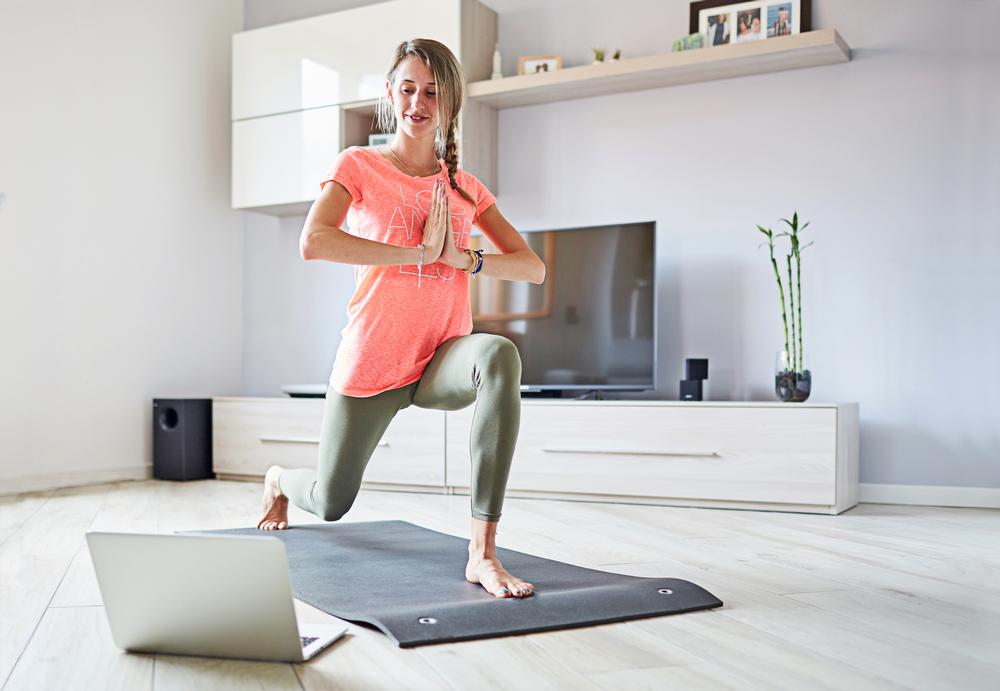
The sector must accept that age is no longer a barrier, so ageism must be stamped out / Photo: shutterstock/Mladen Zivkovic
I’m sticking to my prediction that from now until 2020, the health and fitness sector will continue to break all barriers. It is, and will continue to be, a golden period for fitness.
The consistent methodology used in the data audit and the robust database that lie behind the State of the Fitness Industry Reports focus on key metrics that continue to be very positive for the industry.
The audit and report for the past six years has highlighted that all key indicators – the number of sites, the number of members and the value of the market – have all been growing.
Now add to that the industry’s improved consumer-focused technology – including personalisation, localisation, seamless booking and payment options – and the barriers to participation have been even further eradicated.
For example, just one element of this new consumer-focused technology – online class bookings – jumped from almost zilch five years ago to 46 per cent across the private health and fitness sector today.
Likewise, in the public health and fitness sector, where many operators were quicker to adopt new technology, online bookings now stand at an even more impressive 65 per cent.
LONDON LEADS THE WAY The 2018 State of the Fitness Industry Report highlights how London is leading the way and setting the pace that other parts of the country should be emulating. The capital is over-achieving with one in every five people being a member of a gym, compared with the UK average of just one in seven.
The key penetration rate across the whole population remains at 14.9 per cent for the second year in a row simply due to an increase in total population numbers. To achieve greater penetration, the challenge now is to strive for broader consumer adoption, enabling the industry to push the 14.9 per cent to a more naturally achievable 20 per cent, while London can grow to an easy 25 per cent.
AGEISM IS THE BARRIER The industry also needs to accept that age is no longer a barrier, so ageism needs to be stamped out. At my age it’s something I feel strongly about and, all too often, come across. Gen Z and millennials are merely part of the consumer mix.
The so-called baby boomers are the new demographic cohort that value their health now they’re getting older. Often equipped with the time and money, they can exhibit loyalty to the brands that appreciate them.
JOINING IN I predicted last year that membership numbers would exceed the 10 million mark, and at 9.9 million they were getting very close. The two per cent gain in 2018 was a decrease from the previous year’s whopping 5.1 per cent, but there’s nothing to stop growth at the higher figure.
The 2018 report highlights how smaller sites are giving way to newer, bigger and better-equipped sites. The private sector gained 240,000 members from these new sites. The sites that closed had 26 per cent fewer members and 17 per cent fewer stations than the UK average.
LOW COST HIKE According to the State of the Fitness Industry Reports since 2011, low cost brands have grown from securing less than five per cent of private memberships to 38 per cent in 2018, despite accounting for just 14 per cent of the private sector market.
The top ten low cost brands operate more than 90 per cent of all low cost sites. Many of these operators are discovering that the strength of the market allows them to add value and obtain a higher yield by charging over the original £20 threshold. In fact, more than half of the top ten brands now have an average rack-rate price above £20 and this does not reflect the brands value-added extras.
GO PUBLIC The public sector had a penetration rate of 5.2 per cent in 2014, 2015 and 2016 but dropped to 5.1 per cent in 2017 and to 5.0 per cent in 2018. So one in every 20 people is a member of a public gym and 84 per cent of the population live within two miles of a site.
The top ten public sector operators are bucking the trend, opening collectively 44 more sites and thereby gaining 83,000 members, and they are now responsible for 36 per cent (1.2 million) of all public members. These top ten public operators are responsible for 743 sites, which leaves just less than 2,000 public sites showing signs of some decline – but this is no way terminal or a given.
POSITIVE OUTLOOK Some operators see fitness as a business, but those that treat it as a movement will realise it is ushering in a revolution in the way the consumer feels, relates and participates in fitness.
Rapid changes are afoot with the boutique health and fitness market and its new business models, as well as from the growing trend for live-streaming and on-demand content coming from existing and new brands to all our devices, all of the time. Right here, right now really is a golden period for the industry.
About the author
David Minton
David Minton is director of LeisureDB [email protected]
@davidmintonTLDC
A recent survey by the UK Spa Association (UKSA) into the industry’s approach to cancer care
has revealed that almost half of participating respondents (46 per cent) are unaware that
cancer is a disability and guests with a cancer diagnosis must be given
Mexican operator, Solmar Hotels and Resorts, is hosting a series of events in celebration of
Global Wellness Day, including a Temazcal ceremony at its Playa Grande Resort and Spa in Los
Cabos.
Mandarin Oriental has announced a standalone residence brand, Mansions, which will debut at
Emirates Palace, Mandarin Oriental Mansions, Abu Dhabi, in 2029.
Four Seasons Resort The Nam Hai in Hoi An, Vietnam, has put together a Global Wellness Day
(GWD) agenda with activations rooted in nature and shaped by four pillars of Joy – in
alignment with the day’s theme #JoyMagenta.
The Global Wellness Summit (GWS) will celebrate its 20th anniversary at the 2026 event in
Phuket, Thailand, later this year with the theme: The Science, Art and Soul of Wellness.
Auko, an all-inclusive development, is opening in Phong Nha in Vietnam in Q3 2026, with a
series of 30 tented eco-lodges and wellness hospitality operations by Lumina Wellbeing.
Therme Manchester’s 28-acre development, which will include interconnected glass pavilions
that measure 65,000sq m, will be the largest bathing and wellbeing attraction in the world once
complete, according to prof David Russell, CEO of Therme UK.
Naples Beach Club, a Four Seasons Resort, has opened a 2,800sq m spa called The Sanctuary,
with the design and concept inspired by the Native American people that populated Florida’s
Southwest coast – the Calusa.
Swire Hotels’ luxury hospitality brand Upper House has revealed it will roll out its two-day
House of Healing retreats at its three hotels in Hong Kong, Chengdu and Shanghai.
+ More news
COMPANY PROFILES
Agilysys UK Ltd Agilysys, Inc. (Nasdaq: AGYS), is a leading
global provider of hospitality software
solutions that [more...]