In the fast-paced world of fitness and wellness, where high-intensity workouts push us to
our limits and the sweat pours, the importance of efficient recovery cannot be overstated. ... more
Fitness operators savvy enough to financially reward exemplary exercise instructors benefit from strong retention and membership rates. Finlay Macdonald from Les Mills shares his insights
Instructors are central to the success of fitness clubs as group classes become increasingly popular
If a single great instructor can attract and retain hundreds of members to a health/fitness club over time, it stands to reason that a team of instructors can transform an entire club’s future. Conversely, a club that ignores or undervalues instructor quality risks alienating members and undercutting its own financial performance. Yet many clubs continue to do just that.
INVEST IN INSTRUCTORS According to research white paper The Impact of Instructor Quality In The Physical Activity Sector (May 2019), many club operators are still failing to grasp the true impact great instructors can have on performance – and weakening their bottom line as a result.
Prepared by Les Mills and not-for-profit health body ukactive, the white paper pulls together insights from a range of fitness industry experts, including mainstream and boutique operators, academics, training providers and multiple industry bodies.
The report also looks at relevant in-club examples where operators saw class attendances and retention rise markedly after investing in greater training and pay for instructors.
The white paper delivers five key insights for club operators:
1 Instructors continue to play a central role in the success of clubs, from member retention to marketing. Many members are more loyal to their favourite instructor than to a facility.
2 Group workouts are key to the future of clubs: classes are a major selling point for the new generation of gym members, with 52 per cent of millennials and 50 per cent of Gen Z members engaging in group workouts to enjoy the social benefits of ‘the group effect’.
3 Development of ‘soft skills’ should not be underestimated: the industry must close the skills gaps at the qualification level and invest in quality in-house training and CPD for instructors.
4 Rewards and recognition: while pay is not all that instructors care about, rates have barely increased in 20 years and remain a significant motivator (or demotivator). Operators should explore ways to reward their instructors, not just through increased pay, but also by investing in education and other nonfinancial rewards.
5 Retaining high-quality instructors remains significant for clubs: they possess up-to-date and first-hand insights into the member experience, which operators can harness to understand and improve the member experience and boost retention.
INSTRUCTORS PAY DIVIDENDS “Instructor pay remains one of our sector’s biggest challenges and it’s where boutiques have stolen a march on traditional clubs,” says Phillip Mills, Les Mills International Executive Director.
“US$27 is still the average instructor fee per class in a traditional club – this has barely changed since the 1980s. It’s difficult to recruit a new generation of rock star instructors when personal training and boutiques pay two to three times as much.”
But Mills says there’s a win-win solution that links pay to qualifications and results. In August 2019, Les Mills launched its new Group Fitness Management (GFM) training programme which shows in detail how clubs can achieve just that.
The GFM programme notes that, firstly, current challenges have to be acknowledged. Instructors in traditional clubs are often paid considerably less than the average hourly fee charged by personal trainers, which is exacerbated when you factor in the travel, preparation and set-up time group fitness instructors must invest in, delivering their classes for no extra pay.
This issue makes it increasingly difficult to attract new talent into the fitness industry. The 2018 IHRSA European CEO Study Report surveyed 86 European health club leaders and found that recruiting and retaining great people was still their number one challenge. The resulting smaller talent pool intensifies competition among clubs and drives up the market value of those standout group fitness instructors who can pull in hundreds of loyal followers each week, driving substantial extra revenue for their club.
This effect has been amplified by the boom in boutique gyms, which have thrived by focusing on specialised group fitness experiences and charging upwards of US$50 per class. These higher margins have allowed them to better reward top talent, with standout boutique instructors able to command upwards of US$100 per class.
HANG ONTO INSTRUCTORS So what can traditional health clubs do to better remunerate their top instructors and ensure they aren’t snatched away by boutiques in this highly competitive market?
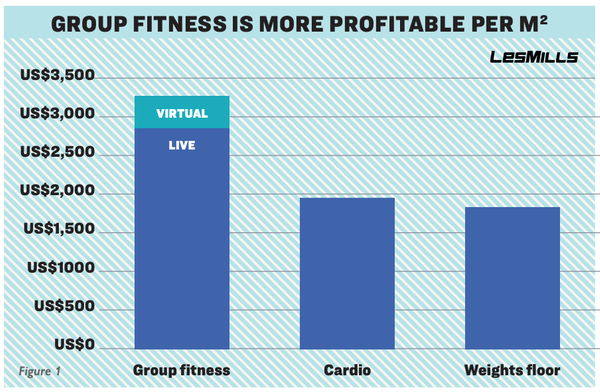
1 SUPERSIZE THE STUDIO One of the biggest untapped assets for traditional clubs is the space they have to create a jumbo group exercise studio. Research has shown that the studio is the most profitable area of the club when built at the right scale (see Figure 1), so those clubs willing to be bold can yield impressive results. Adding virtual classes into the programming mix can also help spread usage and provide off-peak class options for members.
2 PAY ON PERFORMANCE By unlocking the economies of scale that come with a bigger studio, clubs can afford to properly pay top instructors and counter the threat of them being poached by boutiques. Either way, clubs can still incentivise instructors with pay related to how well they fill their classes.
Packed classes mean more members joining and staying for longer, with increased revenues allowing greater investment in instructors. In turn, they’re more likely to invest time and effort marketing their classes through their own social media channels.
3 INVEST IN THE TEAM Club operators are already seeing strong return on investment from focusing on instructors, as evidenced by UK chain Village Gym.
Village’s 30 high-end health clubs saw class attendances jump by up to 40 per cent thanks to a recent focus on upskilling group fitness instructors through Les Mills Advanced Training. Member retention also went up (by an average of 5-10 per cent per month), as did referrals, meaning the better-qualified instructors could receive higher rates of pay. In turn, this led to better instructor engagement and a long list of talented trainers eager to join the Village Gym team.
4 SMART TIMETABLING For those limited by space, there are timetable opportunities to unlock extra cash and reward top instructors.
For example, research has shown that indoor cycling is the most lucrative activity (per square metre) – and it’s one of the hottest categories among consumers.
Findings from the 2019 Les Mills Global Consumer Fitness Survey (involving 12,000 fitness consumers across 22 countries) indicate that 20 per cent of global consumers are doing or would consider doing indoor cycle classes.
5. MONEY ISN’T EVERYTHING Even with the best will in the world, a fitness/health club’s budget can’t always stretch to accommodate increased rates of pay for group fitness instructors. But there are still many other options a club can take to ensure their instructors feel valued and rewarded.
Motivation is the fuel that fires a high-performing group fitness team. Uniting them under a powerful purpose, setting challenging goals and building camaraderie through social activities in another way to add a strong sense of fun to a team’s journey.
Rewarding high performers with opportunities for training and development can also help spark a continuous cycle of improvement. Finally, one of the commonly overlooked factors in motivating a team is simply serving as a good coach who clearly cares about growing their skills and developing them.
THE BOTTOM LINE In summary, there are a variety of ways clubs can leverage instructor quality to improve both the instructors’ own experience and improve the health of the overall business. Instructors are an integral part of the brand. Pay will continue to be an issue – and must be addressed wherever possible – but working together to nurture a stronger culture and better environment for group class instructors will benefit customers, the club’s brand, and ultimately the bottom line of your club.
"Instructor pay remains one of our sector’s biggest challenges and it’s where boutiques
have stolen a march on traditional clubs"
– Phillip Mills, Les Mills International Executive Director
Finlay Macdonald is the Content & Comms Director at Les Mills International.
[email protected]
www.lesmills.com
Class instructors can share their up-to-date and first-hand insights into the gym member experience
Operators should reward group class instructors by investing in
their education and training
Incentivise instructors with pay related to how well they fill their classes to encourage social media engagement
A recent survey by the UK Spa Association (UKSA) into the industry’s approach to cancer care
has revealed that almost half of participating respondents (46 per cent) are unaware that
cancer is a disability and guests with a cancer diagnosis must be given
Mexican operator, Solmar Hotels and Resorts, is hosting a series of events in celebration of
Global Wellness Day, including a Temazcal ceremony at its Playa Grande Resort and Spa in Los
Cabos.
Mandarin Oriental has announced a standalone residence brand, Mansions, which will debut at
Emirates Palace, Mandarin Oriental Mansions, Abu Dhabi, in 2029.
Four Seasons Resort The Nam Hai in Hoi An, Vietnam, has put together a Global Wellness Day
(GWD) agenda with activations rooted in nature and shaped by four pillars of Joy – in
alignment with the day’s theme #JoyMagenta.
The Global Wellness Summit (GWS) will celebrate its 20th anniversary at the 2026 event in
Phuket, Thailand, later this year with the theme: The Science, Art and Soul of Wellness.
Auko, an all-inclusive development, is opening in Phong Nha in Vietnam in Q3 2026, with a
series of 30 tented eco-lodges and wellness hospitality operations by Lumina Wellbeing.
Therme Manchester’s 28-acre development, which will include interconnected glass pavilions
that measure 65,000sq m, will be the largest bathing and wellbeing attraction in the world once
complete, according to prof David Russell, CEO of Therme UK.
Naples Beach Club, a Four Seasons Resort, has opened a 2,800sq m spa called The Sanctuary,
with the design and concept inspired by the Native American people that populated Florida’s
Southwest coast – the Calusa.
Swire Hotels’ luxury hospitality brand Upper House has revealed it will roll out its two-day
House of Healing retreats at its three hotels in Hong Kong, Chengdu and Shanghai.
+ More news
COMPANY PROFILES
Gharieni Group For 35 years, the Gharieni Group has
redefined wellness, spa and medical
equipment, setting global [more...]