bbspa_Group
 bbspa_Group
 bbspa_Group
 
EMPLOYERS: POST A JOB
Free ezines & magazines
News Video Training Products Magazines Spa Business spa-kit Handbook What's on Advertise Subscribe
Catalogue gallery
More catalogues
Diary dates
Powered by leisurediary.com
09-11 Jun 2026
Savutuvan Apaja, Haapaniemi, Finland
09-12 Jun 2026
Hotel Cascais Miragem Health & Spa, Portugal
21-23 Jun 2026
Midlands (Venue TBA), Liphook, United Kingdom
22-22 Jun 2026
Worldwide,
03-05 Jul 2026
Copenhagen, Copenhagen, Denmark
19-21 Jul 2026
The Global Ambassador , Phoenix, United States
22-25 Jul 2026
The Global Ambassador , Phoenix, United States
23-26 Aug 2026
The Riviera Maya Edition Kanai, Playa del Carmen, Mexico
Tourism industry must lead and inspire, says Ken Robinson
By Liz Terry 15 Apr 2020
OPINION

TOURISM IN A POST-CORONAVIRUS WORLD

By Ken Robinson CBE, tourism expert.

Coronavirus is devastating for the tourism and leisure sectors globally.

For now, the focus is on business ‘discontinuity’, the impact of the pandemic on our employees and their families, whether and how companies will survive and when the viable resumption of activity will be possible.

In my view, we have every reason to be hopeful and confident for the future, because the inexorable growth of travel and tourism has shown that travel and tourism is aspirational – when people can travel they will.

Optimistic, braver and more farsighted individuals and organisations are already summoning up their bulldog spirit and looking to the future.

The media and politicians vie to predict how soon the lockdown will end and everyone is seeking to define our ‘exit strategy’.

But I sense that few appreciate how massively devastating the pandemic is likely to be, or how long it will be before recovery to post-pandemic levels is practical.

For us in the UK there is light at the end of the tunnel, but worldwide evidence shows lockdowns are effective in slowing infection rates, but they don’t lead to immunity beyond the minority who’ve been infected and recover. The lockdown shields the most vulnerable, but only as long as it lasts. The rules will be relaxed, a little and for a while, but have to be reintroduced if, as seems certain, infection rates climb again.

Time to rebuild
There is already a determination to rebuild, so what can be foreseen? Although international tourism will be decimated post-pandemic, there will be great economic and pressures to resume and for consumers who can afford to, there will be a strong pent-up demand for holidays at home and abroad.

But, the aspiration to travel has pre-requirements, the most relevant of which is that tourists only go to safe and healthy places. Until this can be assured – both en route and at the destination – tourism volumes will be minimal.

The developing world
While the pandemic is devastating communities and economic life in most developed countries and causing tragic loss to so many families, these impacts are as nothing compared to its likely effects on the populations and economies of countries in the developing world that in recent years have become some of the fastest-growing tourism destinations. Tourism revenues have become essential to the functioning and growth of their economies and social systems.

These destinations, with their densely populated cities and towns and sparsely populated rural areas, have very limited medical services – few doctors and resource-starved healthcare systems. Coronavirus, when it takes hold, is likely to kill an unimaginable number of people and remain infectious in the population for years.

Conditions for recovery
The key to the recovery of tourism will be immunity. If this is a reliable consequence of post-infection-recovery, and immunisation is available for all those who escape infection, I anticipate a requirement on individuals to prove their immunity before being allowed to travel – at least internationally.

Such proof will also be a requirement for everyone working in the travel and accommodation service chain – in other words at all stages of travel, and at all places and facilities visited.

This ‘proof’ could work like a visa, international driving license, or work permit. In the 1950s and 1960s immunisation had to be recorded in passports, and was required at many destinations. Fraudulent and forged certification will be a hazard, especially in less regulated economies.

Even once it’s officially permissible to travel, the most lucrative tourists – mature adults and seniors who have the most available time and can afford to travel – will be those at highest risk of infection and death and so will be slow to do so.

Limited ‘essential’ travel will be permitted, with social distancing and regulation, for an indeterminate period. However, freely-chosen leisure travel by the general public will be impeded for a very long time.

Airlines will be slow to resume frequent schedules, so there will be limited capacity. Levels of demand at resort-style destinations will be sparse and grow slowly, so businesses at formerly popular destinations will only be able to re-open when levels of demand reach their operational viability thresholds.

Domestic before international
Domestic tourism will recover first, but slowly, with limitations and controls and at different rates for different types of activity. Conditions and rules may vary by location. The earliest resumption is likely where social distancing and family isolation is practical, such as self-catering accommodation.

Governments will more keenly appreciate the economic benefits and necessity of the tourism sector in supporting wellbeing and quality of life and will value and support the industry more.

Internationally, where adjacent countries have comparable rules and trust each other, limited land border travel will be possible.

Travel industry infrastructure
In the longer-term, assuming a state of healthy equilibrium can be assured, it will be necessary to repair and rebuild travel industry networks and contractual linkages.

For much of the industry, it will almost be like starting again and this will make communication and marketing, in a chaotically fragmented world, absolutely key.

Online dealings will have become more embedded, and physical transactions, materials, and content will be much less in use than in the past. However, tourism has always been a person to person business, and it will be in the future. Trusted, safe, close personal interaction is essential and will be greatly appreciated by people who have been isolated by the pandemic.

Plan to relaunch
During this period of enforced closure, there is much the industry can do.

Tourism is an interconnected sector and although many businesses have evolved to be mutually competitive, links exist for communication and cooperation and there is great potential to make them more effective.

In the UK, we no longer have the structure of national and regional tourist boards and public-private partnerships between local authorities and industry. Prior to 2000 these two were contractually linked and organised around national policies and strategies. There’s no such functioning network now, just an underfunded VisitBritain and it's residual Visit England with loose communication links to the disparate plethora of so-called ‘Destination Management Organisations’.

We need a much more effective, mutually-cooperative network for recovery and to optimise the future economic, social and cultural benefits of tourism.

Given the weakness of the present arrangements between our national boards and industry, there’s surely the opportunity to speedily strengthen the links and create a trusted central hub for information, foresight, liaison, inspiration and in all ways position ourselves to be in the best possible condition to develop in the new world.

Until then, the biggest opportunities for tourist boards and destination organisations are around maintaining their networks of members and partners and preparing the most enjoyable, evocative, experiential materials possible for use online and via ‘push’ distribution.

Connecting with consumers
We need to keep our relationships and brands alive among audiences who have been starved of the joy and life-enhancing experiences that tourism brought to their lives.

We must also be inventive and use our assets and our networks of contacts with existing and potential customers to evolve new experiences with creative ideas such as quizzes, virtual treasure hunts, discovery series or compiling online photo books from contributions by visitors and tourists. The list of possibilities is endless.

Tourism businesses in collaborative partnerships should take a leadership role to inform and inspire this work – both as a service and to keep those relationships alive. Keeping up public awareness of destinations can also help strengthen and build national, regional and local pride and morale – not least within hard-hit tourism and travel businesses and among the professionals who work within them.

Future marketing will be very different, although how is currently unclear. Consumers are likely to have a different, more cautious approach to belief in the accuracy of information, the trustworthiness of travel providers, the safety of their payments, and provisions for reimbursement and compensation.

In summary, we need to regularly remind ourselves that travel and tourism is aspirational and that when people can travel they will. They need the available time, money and permission to travel, but even then most will only choose safe and healthy places.

There will be recovery – when, and at what pace, nobody knows. Meanwhile, we need to be realistic and accept unchangeable realities.

The whole world is in the same situation – our challenge is to be ready when the new opportunities emerge, to be ahead of the game, and be an inspiration to others.

We must all work for a future where the economic, social and cultural benefits of tourism are available to all.

Ken Robinson CBE 14 April 2020
[email protected]

Ken Robinson is an Adviser and Consultant on tourism; strategic planning, development and optimising the economic and social benefits of tourism. His specialism is the analysis, development planning, management and marketing of visitor attractions and related tourism facilities


News
1 to 12 of 9470 news stories
10 Jun 2026
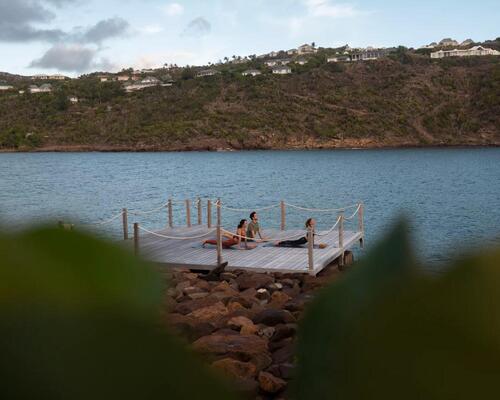
Rosewood Le Guanahani St Barth, on the northeast coast of Saint Barthélemy in the French West Indies, is offering a programme of ocean-inspired yoga classes between 8-14 June to celebrate Global Wellness Day (GWD). GWD ... More
09 Jun 2026
The Ritz-Carlton, Langkawi, in Malaysia, has revealed a schedule for Global Wellness Day (GWD) that includes guided rainforest walks, mindful movement and guided coastal meditation experiences. Founded in 2012 by Belgin Aksoy in Turkey, GWD ... More
05 Jun 2026
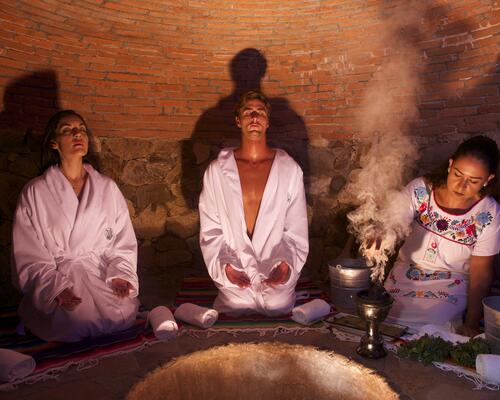
Mexican operator, Solmar Hotels and Resorts, is hosting a series of events in celebration of Global Wellness Day, including a Temazcal ceremony at its Playa Grande Resort and Spa in Los Cabos. The not-for-profit movement, ... More
12 Jun 2026
Global Wellness Day (GWD) will mark its 15th anniversary on Saturday 13 June 2026, with the theme: #JoyMagenta – a celebration of the healing qualities of simple gestures and activities that spark joy. Founded in ... More
03 Jun 2026
Four Seasons Resort The Nam Hai in Hoi An, Vietnam, has put together a Global Wellness Day (GWD) agenda with activations rooted in nature and shaped by four pillars of Joy – in alignment with ... More
01 Jun 2026
Rainer Maelzer, an experiential entertainment innovator, has been appointed chief entertainment officer by Therme Group.  With decades of experience in immersive water-based attractions, Maelzer will lead the development and global delivery of the company’s recreational ... More
03 Jun 2026
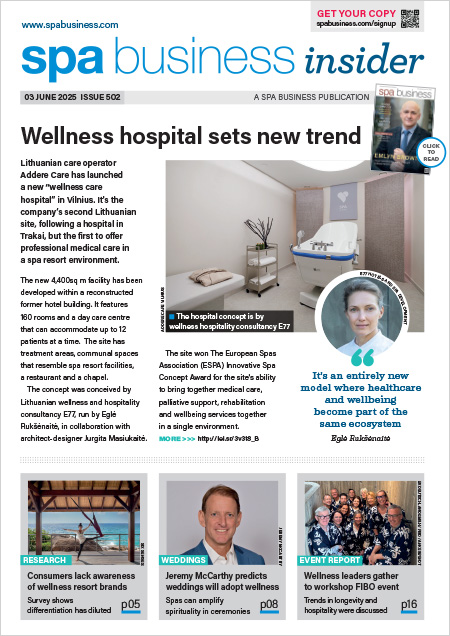
Lithuanian care operator Addere Care has launched a “wellness care hospital” in Vilnius. It's the company’s second Lithuanian site, following a hospital in Trakai, but the first to offer professional medical care in a spa ... More
28 May 2026
Auko, an all-inclusive development, is opening in Phong Nha in Vietnam in Q3 2026, with a series of 30 tented eco-lodges and wellness hospitality operations by Lumina Wellbeing. Van Phu Real Estate Development JSC owns ... More
05 Jun 2026
A recent survey by the UK Spa Association (UKSA) into the industry’s approach to cancer care has revealed that almost half of participating respondents (46 per cent) are unaware that cancer is a disability and ... More
26 May 2026
Wellness and hospitality thought leaders gathered recently for a workshop at Yasuragi, the Japanese spa and conference hotel near Stockholm. The purpose was to shape the FIBO Longevity and Hospitality Summit, which will happen in ... More
27 May 2026
LVMH-owned beauty house Guerlain will launch up to five spas with partners a year as part of its plan to expand globally, according to the brand’s international spa and wellness director, Diane Davody. In an ... More
27 May 2026
A new global study by Kevin Kelly and Peter Yesawich, called WELLSurvey 2.0, has revealed more than half of consumers in the UK, US and Germany would not choose numerous high-profile wellness resort brands  for ... More
     
International SPA Association - iSPA
Spa Life International
Company Profile
HPO.Tech Hyperbaric Systems
Founded in 2020 in Istanbul, HPO.Tech combines 15+ years of expertise in hyperbaric technology, [more]
 
MORE PROFILES
Featured Supplier
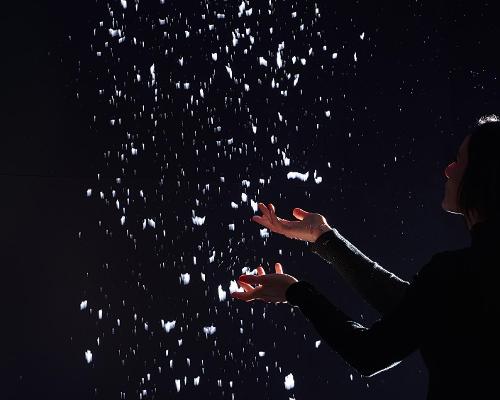
Embrace the chill: TechnoAlpin's Snowsky revolutionises post-fitness recovery with falling snow
In the fast-paced world of fitness and wellness, where high-intensity workouts push us to our limits and the sweat pours, the importance of efficient recovery cannot be overstated. ... more
The Leisure Media Company Ltd
Product news
Rebalance Tech ramps up Impulse rollout
Voya launches Resurge Hair and Scalp Elixir and spa treatments
Nilo Spa Design introduces Marea dry flotation bed
Esse Skincare upgrades Probiotic Serum with fourth live probiotic species
Sweet Bee Organics enters spa market at The Ned London with magnesium-infused treatment
Templespa releases brightening Glass Act eye serum
Directory

 
JOBS
NEWS
VIDEO
TRAINING
PRODUCTS
MAGAZINE
 
SPA BUSINESS
SPA-KIT.NET
SPA BUSINESS HANDBOOK
SUBSCRIBE
ADVERTISE
FREE DIGITAL SUBSCRIPTIONS
CONTACT US

Leisure Media
Tel: +44 (0)1462 431385

©Cybertrek 2026


 bbspa_Group
 bbspa_Group
 bbspa_Group
 bbspa_Group
News   Products   Magazine
NEWS
Tourism industry must lead and inspire, says Ken Robinson
POSTED 15 Apr 2020 . BY Liz Terry
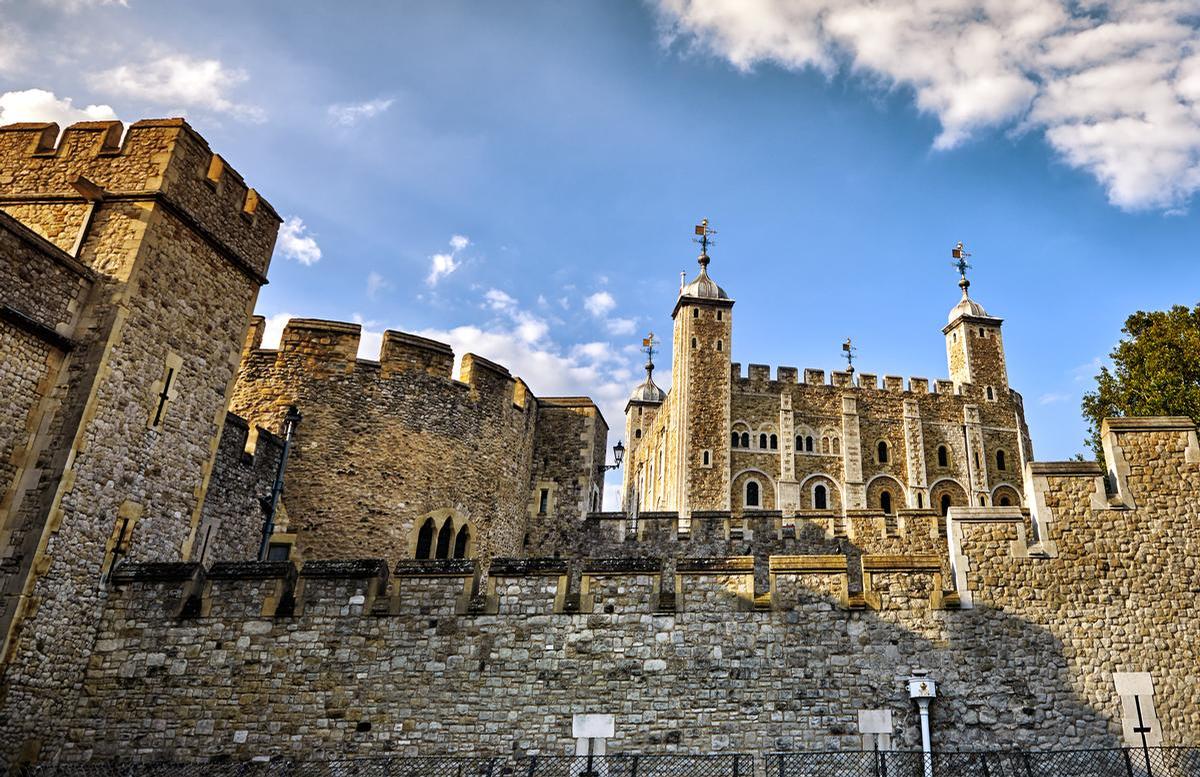
Some tourism assets will survive the shutdown, others will not Credit: Historic Royal Palaces
We need to regularly remind ourselves that travel and tourism is aspirational and that when people can travel they will
– Ken Robinson CBE
OPINION

TOURISM IN A POST-CORONAVIRUS WORLD

By Ken Robinson CBE, tourism expert.

Coronavirus is devastating for the tourism and leisure sectors globally.

For now, the focus is on business ‘discontinuity’, the impact of the pandemic on our employees and their families, whether and how companies will survive and when the viable resumption of activity will be possible.

In my view, we have every reason to be hopeful and confident for the future, because the inexorable growth of travel and tourism has shown that travel and tourism is aspirational – when people can travel they will.

Optimistic, braver and more farsighted individuals and organisations are already summoning up their bulldog spirit and looking to the future.

The media and politicians vie to predict how soon the lockdown will end and everyone is seeking to define our ‘exit strategy’.

But I sense that few appreciate how massively devastating the pandemic is likely to be, or how long it will be before recovery to post-pandemic levels is practical.

For us in the UK there is light at the end of the tunnel, but worldwide evidence shows lockdowns are effective in slowing infection rates, but they don’t lead to immunity beyond the minority who’ve been infected and recover. The lockdown shields the most vulnerable, but only as long as it lasts. The rules will be relaxed, a little and for a while, but have to be reintroduced if, as seems certain, infection rates climb again.

Time to rebuild
There is already a determination to rebuild, so what can be foreseen? Although international tourism will be decimated post-pandemic, there will be great economic and pressures to resume and for consumers who can afford to, there will be a strong pent-up demand for holidays at home and abroad.

But, the aspiration to travel has pre-requirements, the most relevant of which is that tourists only go to safe and healthy places. Until this can be assured – both en route and at the destination – tourism volumes will be minimal.

The developing world
While the pandemic is devastating communities and economic life in most developed countries and causing tragic loss to so many families, these impacts are as nothing compared to its likely effects on the populations and economies of countries in the developing world that in recent years have become some of the fastest-growing tourism destinations. Tourism revenues have become essential to the functioning and growth of their economies and social systems.

These destinations, with their densely populated cities and towns and sparsely populated rural areas, have very limited medical services – few doctors and resource-starved healthcare systems. Coronavirus, when it takes hold, is likely to kill an unimaginable number of people and remain infectious in the population for years.

Conditions for recovery
The key to the recovery of tourism will be immunity. If this is a reliable consequence of post-infection-recovery, and immunisation is available for all those who escape infection, I anticipate a requirement on individuals to prove their immunity before being allowed to travel – at least internationally.

Such proof will also be a requirement for everyone working in the travel and accommodation service chain – in other words at all stages of travel, and at all places and facilities visited.

This ‘proof’ could work like a visa, international driving license, or work permit. In the 1950s and 1960s immunisation had to be recorded in passports, and was required at many destinations. Fraudulent and forged certification will be a hazard, especially in less regulated economies.

Even once it’s officially permissible to travel, the most lucrative tourists – mature adults and seniors who have the most available time and can afford to travel – will be those at highest risk of infection and death and so will be slow to do so.

Limited ‘essential’ travel will be permitted, with social distancing and regulation, for an indeterminate period. However, freely-chosen leisure travel by the general public will be impeded for a very long time.

Airlines will be slow to resume frequent schedules, so there will be limited capacity. Levels of demand at resort-style destinations will be sparse and grow slowly, so businesses at formerly popular destinations will only be able to re-open when levels of demand reach their operational viability thresholds.

Domestic before international
Domestic tourism will recover first, but slowly, with limitations and controls and at different rates for different types of activity. Conditions and rules may vary by location. The earliest resumption is likely where social distancing and family isolation is practical, such as self-catering accommodation.

Governments will more keenly appreciate the economic benefits and necessity of the tourism sector in supporting wellbeing and quality of life and will value and support the industry more.

Internationally, where adjacent countries have comparable rules and trust each other, limited land border travel will be possible.

Travel industry infrastructure
In the longer-term, assuming a state of healthy equilibrium can be assured, it will be necessary to repair and rebuild travel industry networks and contractual linkages.

For much of the industry, it will almost be like starting again and this will make communication and marketing, in a chaotically fragmented world, absolutely key.

Online dealings will have become more embedded, and physical transactions, materials, and content will be much less in use than in the past. However, tourism has always been a person to person business, and it will be in the future. Trusted, safe, close personal interaction is essential and will be greatly appreciated by people who have been isolated by the pandemic.

Plan to relaunch
During this period of enforced closure, there is much the industry can do.

Tourism is an interconnected sector and although many businesses have evolved to be mutually competitive, links exist for communication and cooperation and there is great potential to make them more effective.

In the UK, we no longer have the structure of national and regional tourist boards and public-private partnerships between local authorities and industry. Prior to 2000 these two were contractually linked and organised around national policies and strategies. There’s no such functioning network now, just an underfunded VisitBritain and it's residual Visit England with loose communication links to the disparate plethora of so-called ‘Destination Management Organisations’.

We need a much more effective, mutually-cooperative network for recovery and to optimise the future economic, social and cultural benefits of tourism.

Given the weakness of the present arrangements between our national boards and industry, there’s surely the opportunity to speedily strengthen the links and create a trusted central hub for information, foresight, liaison, inspiration and in all ways position ourselves to be in the best possible condition to develop in the new world.

Until then, the biggest opportunities for tourist boards and destination organisations are around maintaining their networks of members and partners and preparing the most enjoyable, evocative, experiential materials possible for use online and via ‘push’ distribution.

Connecting with consumers
We need to keep our relationships and brands alive among audiences who have been starved of the joy and life-enhancing experiences that tourism brought to their lives.

We must also be inventive and use our assets and our networks of contacts with existing and potential customers to evolve new experiences with creative ideas such as quizzes, virtual treasure hunts, discovery series or compiling online photo books from contributions by visitors and tourists. The list of possibilities is endless.

Tourism businesses in collaborative partnerships should take a leadership role to inform and inspire this work – both as a service and to keep those relationships alive. Keeping up public awareness of destinations can also help strengthen and build national, regional and local pride and morale – not least within hard-hit tourism and travel businesses and among the professionals who work within them.

Future marketing will be very different, although how is currently unclear. Consumers are likely to have a different, more cautious approach to belief in the accuracy of information, the trustworthiness of travel providers, the safety of their payments, and provisions for reimbursement and compensation.

In summary, we need to regularly remind ourselves that travel and tourism is aspirational and that when people can travel they will. They need the available time, money and permission to travel, but even then most will only choose safe and healthy places.

There will be recovery – when, and at what pace, nobody knows. Meanwhile, we need to be realistic and accept unchangeable realities.

The whole world is in the same situation – our challenge is to be ready when the new opportunities emerge, to be ahead of the game, and be an inspiration to others.

We must all work for a future where the economic, social and cultural benefits of tourism are available to all.

Ken Robinson CBE 14 April 2020
[email protected]

Ken Robinson is an Adviser and Consultant on tourism; strategic planning, development and optimising the economic and social benefits of tourism. His specialism is the analysis, development planning, management and marketing of visitor attractions and related tourism facilities

RELATED STORIES
Attractions heads urged to review protocols following Manchester terrorist attack


Tourism expert Ken Robinson has urged attractions bosses to review government guidelines on counter terrorism following this week’s bombing of Manchester Arena.
TEA bringing SATE event to UK in 2017


Taking place between 4-5 May, the TEA conference will bring together industry professionals, academics, attractions operators and owners to discuss a number of topics surrounding development for the future for cultural visitor attractions.
FEATURE: Editor's letter: Advance ticketing


Attractions are the last bastion of the 'pay on the gate' approach and it's time For this to change
10th Annual National Conference of Visitor Attractions is today


The Annual National Conference of Visitor Attractions (VAC 2013) event for all types of attractions in the UK is being held today (10 October) at the Queen Elizabeth II Conference Centre, London.
MORE NEWS
Almost half of spa survey respondents are unaware cancer is a disability and not adapting treatments is discrimination
A recent survey by the UK Spa Association (UKSA) into the industry’s approach to cancer care has revealed that almost half of participating respondents (46 per cent) are unaware that cancer is a disability and guests with a cancer diagnosis must be given
Solmar Hotels and Resorts offers Temazcal ceremony for Global Wellness Day
Mexican operator, Solmar Hotels and Resorts, is hosting a series of events in celebration of Global Wellness Day, including a Temazcal ceremony at its Playa Grande Resort and Spa in Los Cabos.

Mandarin Oriental announces standalone Mansions-branded residences for Abu Dhabi
Mandarin Oriental has announced a standalone residence brand, Mansions, which will debut at Emirates Palace, Mandarin Oriental Mansions, Abu Dhabi, in 2029.
Healing sanctuary Tulah Clinical Wellness opens in Kerala
Tulah Clinical Wellness, a holistic wellness destination, has officially opened in the hills of northern Kerala, India.
Four Seasons Resort The Nam Hai creates Global Wellness Day programme rooted in nature
Four Seasons Resort The Nam Hai in Hoi An, Vietnam, has put together a Global Wellness Day (GWD) agenda with activations rooted in nature and shaped by four pillars of Joy – in alignment with the day’s theme #JoyMagenta.
Wellness care hospital opens in Vilnius with innovative spa and hospitality concept
Lithuanian care operator Addere Care has launched a new “wellness care hospital” in Vilnius.
+ More news   
 
COMPANY PROFILES
Seed To Skin

Founded by Jeanette Thottrup in 2018, in Tuscany, Seed to Skin is an award winning skincare line. [more...]
+ More profiles  
DIRECTORY
+ More directory  
DIARY


09-11 Jun 2026

World Sauna Forum 2026

Savutuvan Apaja, Haapaniemi, Finland
09-12 Jun 2026

W3Spa EMEA

Hotel Cascais Miragem Health & Spa, Portugal
+ More diary  


CONTACT US

Leisure Media
Tel: +44 (0)1462 431385

©Cybertrek 2026

ABOUT LEISURE MEDIA
LEISURE MEDIA MAGAZINES
LEISURE MEDIA HANDBOOKS
LEISURE MEDIA WEBSITES
LEISURE MEDIA PRODUCT SEARCH
PRINT SUBSCRIPTIONS
FREE DIGITAL SUBSCRIPTIONS