Spa Life International
 
EMPLOYERS: POST A JOB
Free ezines & magazines
News Video Training Products Magazines Spa Business spa-kit Handbook What's on Advertise Subscribe
Catalogue gallery
More catalogues
Diary dates
Powered by leisurediary.com
09-11 Jun 2026
Savutuvan Apaja, Haapaniemi, Finland
09-12 Jun 2026
Hotel Cascais Miragem Health & Spa, Portugal
21-23 Jun 2026
Midlands (Venue TBA), Liphook, United Kingdom
22-22 Jun 2026
Worldwide,
03-05 Jul 2026
Copenhagen, Copenhagen, Denmark
19-21 Jul 2026
The Global Ambassador , Phoenix, United States
22-25 Jul 2026
The Global Ambassador , Phoenix, United States
23-26 Aug 2026
The Riviera Maya Edition Kanai, Playa del Carmen, Mexico
Active Lives survey reports latest health club and physical activity numbers
By Tom Walker 21 Apr 2023
The number of adults taking part in fitness activities has seen significant rises over the last 12 months, but remains below pre-pandemic levels Credit: Shutterstock/SeventyFour
Physical activity levels among adults in England have returned to pre-pandemic levels
63.1% of the adult population takes part in at least 150 minutes of moderate intensity physical activity each week
A quarter (25.8%) of the population are classed as inactive
The figures come from the Active Lives report, from Sport England
Overall physical activity levels among adults in England have returned to pre-pandemic levels, being in line with 2018-19 and above 2016 numbers.

According to the latest Active Lives report, from Sport England, nearly two-thirds (63.1 per cent) of the adult population were classified as 'active', undertaking at least 150 minutes of moderate-intensity physical activity each week, during the period between November 2021 and November 2022, with a further 11.1 per cent classified as 'fairly active' at 30 - 149 minutes a week, meaning 74.2 per cent of UK adults are undertaking some form of meaningful exercise.

When it comes to the inactive, levels are now above pre-pandemic levels, with a quarter (25.8 per cent) of the population classed as inactive (averaging fewer than 30 minutes of exercise a week).

The types of activities people are undertaking were also researched.

Going to the gym and other fitness activities have seen significant rises over the last 12 months, up from 11.4m in November 2021 to 12.5m in November 2022, although both remain below their pre-pandemic levels, with fitness still down by 1.4m when compared to Nov 2018-19.

Numbers for health club visits between 2016 and 2022 are as follows: 2016-17 – 13.2m, 2017-18 – 13.5m, 2018-19 13.9m, 2019-20 12.7m, 2020-21 11.4m, 2021-22 12.5m

Football saw an increase of 561,000 regular players in the year from November 2021 to 2022, while cricket (up 124,000), netball (up 139,000) and basketball (up 57,000) also saw growth.

Cycling for leisure and sport and running (includes treadmill) had slightly falling numbers before the pandemic and both saw numbers increase during it. However, since the pandemic we’ve seen different outcomes for each, with cycling for leisure and sport remaining up on pre-pandemic numbers by just over 300,000 and running dropping further, continuing the prior trend (down by nearly 1m since Nov 15-16).

Swimming and team sports both had downward trends before the pandemic but were perhaps the most impacted activities given the nature and locations of taking part in them. While swimming has seen significant recovery, levels remain below pre-pandemic and we see a continuation of the downward trend (down by just over 1m since Nov 15-16). In contrast, team sports has recovered to pre-pandemic levels with indications of a stabilisation at around 3.1m players.

Overall, the data shows that the scale of recovery has varied across different sections of society with women, those from lower socio-economic groups and black and Asian people still less likely to be active than others.

Age continues to be a major factor that determines how likely a person is to be physically active.

In the report, Sport England states: "The older a person is the less likely they are to meet the Chief Medical Officers’ guidelines.

"However, this masks some long-term trends and, despite a significant recovery over the last year, there are now nearly half a million fewer active young people (aged 16-34) than six years ago.

"Conversely, we were seeing significant progress in older adults’ activity levels prior to the pandemic and these continued to increase once restrictions were lifted. There are now 1.3m (5.0 per cent) more active 55-74-year-olds and just over half a million (7.8 per cent) more active people aged 75+ than there were in November 2015-16."

The most deprived places (IMD 1-3) fared worst, with activity levels remaining below both pre-pandemic (down 3.1 per cent) and November 2015-16 levels (down 2.6 per cent).

Tim Hollingsworth, CEO of Sport England, said: "The pandemic was an unprecedented challenge to community sport and activity in England, so it’s great news that the overall number of people being physically active has bounced back to pre-pandemic levels.

“We know, however, that there is still much to do. It’s clear that alongside continuing significant financial challenges, the recovery has not been universal, and today’s report provides further evidence that some groups face more barriers to being active than others.

“That’s exactly why our Uniting the Movement strategy continues to see us work with our partners to disproportionately focus resources and funding toward the people and places that need the most support to be active.

“Today’s data also shows the challenge facing the country in ensuring young adults continue to engage with physical activity and we’ll work with our partners to ensure the offer available to this group remains relevant and accessible.”

Given its importance to healthy ageing and overall wellbeing, Sport England has been tracking strength training (muscle strengthening) as a separate category and reports on this in Active Lives, observing no change to average participation, but showing that there's been a decline in women participating, offset by an increase in men. A drop among those aged 35-54 (-1.2 per cent) is countered by an increase among those aged 55-74 (+1.0 per cent).

The proportion of those meeting the guideline continue to decline with age, with a sharp drop at age 75 or over (to 29 per cent).

There’s been a small increase in those with a disability or long-term health condition meeting muscle strengthening guidelines (+1.5 per cent), while the least affluent groups (NS-SEC 6-8) remain less likely to meet the guideline (33 per cent vs. 52 per cent for the most affluent). Despite increases for Asian (excluding Chinese) of +3.0 per cent and Chinese (+6.9 per cent) adults, those from Black (40 per cent), Asian (excluding Chinese) (38 per cent) and other (37 per cent) ethnic groups continue to be the least likely to meet the guideline.

Commenting on the figures, Huw Edwards, CEO at ukactive, said: "The findings show the essential role of gyms, pools and leisure facilities in driving this recovery, with overall fitness activities up by 2.3 per cent on last year and gym sessions (2.8 per cent) and swimming (3.9 per cent) also bouncing back to meet strong consumer demand.

“While the return to pre-pandemic levels is positive, we should have ambitions to greatly increase the number of people being physically active. This is what the Government’s upcoming Sports Strategy must deliver by empowering the physical activity sector to grow and helping more people be more active, more often.

“We must do more to address the ongoing inequalities in our communities which were exacerbated by the pandemic and are still struggling to recover, with the number of active people in England’s least affluent areas activity levels down 3.1 per cent compared to 2018/19.

“Fitness and leisure facilities are essential for the health of these communities and while the government has committed to £63m of funding to prevent further closures of pools and leisure centres due to high energy costs, a long-term strategy is critical," said Edwards.

To download the full Active Lives report, click here.



News
1 to 12 of 9470 news stories
10 Jun 2026
Rosewood Le Guanahani St Barth, on the northeast coast of Saint Barthélemy in the French West Indies, is offering a programme of ocean-inspired yoga classes between 8-14 June to celebrate Global Wellness Day (GWD). GWD ... More
09 Jun 2026
The Ritz-Carlton, Langkawi, in Malaysia, has revealed a schedule for Global Wellness Day (GWD) that includes guided rainforest walks, mindful movement and guided coastal meditation experiences. Founded in 2012 by Belgin Aksoy in Turkey, GWD ... More
05 Jun 2026
Mexican operator, Solmar Hotels and Resorts, is hosting a series of events in celebration of Global Wellness Day, including a Temazcal ceremony at its Playa Grande Resort and Spa in Los Cabos. The not-for-profit movement, ... More
12 Jun 2026
Global Wellness Day (GWD) will mark its 15th anniversary on Saturday 13 June 2026, with the theme: #JoyMagenta – a celebration of the healing qualities of simple gestures and activities that spark joy. Founded in ... More
03 Jun 2026
Four Seasons Resort The Nam Hai in Hoi An, Vietnam, has put together a Global Wellness Day (GWD) agenda with activations rooted in nature and shaped by four pillars of Joy – in alignment with ... More
01 Jun 2026
Rainer Maelzer, an experiential entertainment innovator, has been appointed chief entertainment officer by Therme Group.  With decades of experience in immersive water-based attractions, Maelzer will lead the development and global delivery of the company’s recreational ... More
03 Jun 2026
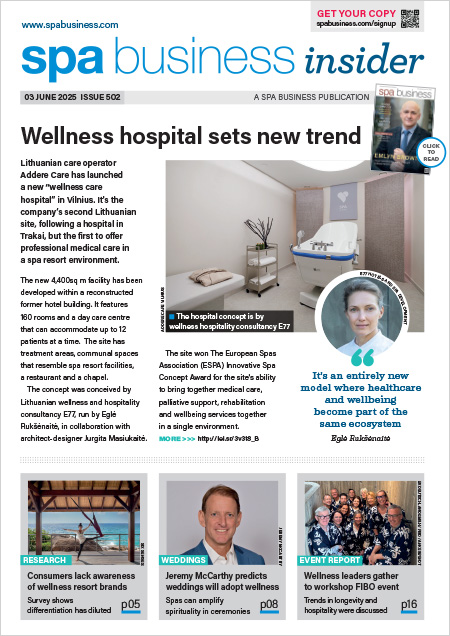
Lithuanian care operator Addere Care has launched a “wellness care hospital” in Vilnius. It's the company’s second Lithuanian site, following a hospital in Trakai, but the first to offer professional medical care in a spa ... More
28 May 2026
Auko, an all-inclusive development, is opening in Phong Nha in Vietnam in Q3 2026, with a series of 30 tented eco-lodges and wellness hospitality operations by Lumina Wellbeing. Van Phu Real Estate Development JSC owns ... More
05 Jun 2026
A recent survey by the UK Spa Association (UKSA) into the industry’s approach to cancer care has revealed that almost half of participating respondents (46 per cent) are unaware that cancer is a disability and ... More
26 May 2026
Wellness and hospitality thought leaders gathered recently for a workshop at Yasuragi, the Japanese spa and conference hotel near Stockholm. The purpose was to shape the FIBO Longevity and Hospitality Summit, which will happen in ... More
27 May 2026
LVMH-owned beauty house Guerlain will launch up to five spas with partners a year as part of its plan to expand globally, according to the brand’s international spa and wellness director, Diane Davody. In an ... More
27 May 2026
A new global study by Kevin Kelly and Peter Yesawich, called WELLSurvey 2.0, has revealed more than half of consumers in the UK, US and Germany would not choose numerous high-profile wellness resort brands  for ... More
     
International SPA Association - iSPA
Templespa Ltd
Company Profile
marocMaroc
Since its creation in 2007, MarocMaroc has invited the world to explore Moroccan beauty through a [more]
 
MORE PROFILES
Featured Supplier
Meet Desert Therapy: Aromatherapy Associates' first new blend in seven years
There is a particular quality of stillness found only in the desert. ... more
 bbspa_Group
Product news
Rebalance Tech ramps up Impulse rollout
Voya launches Resurge Hair and Scalp Elixir and spa treatments
Nilo Spa Design introduces Marea dry flotation bed
Esse Skincare upgrades Probiotic Serum with fourth live probiotic species
Sweet Bee Organics enters spa market at The Ned London with magnesium-infused treatment
Templespa releases brightening Glass Act eye serum
Directory

 
JOBS
NEWS
VIDEO
TRAINING
PRODUCTS
MAGAZINE
 
SPA BUSINESS
SPA-KIT.NET
SPA BUSINESS HANDBOOK
SUBSCRIBE
ADVERTISE
FREE DIGITAL SUBSCRIPTIONS
CONTACT US

Leisure Media
Tel: +44 (0)1462 431385

©Cybertrek 2026


Spa Life International
News   Products   Magazine
NEWS
Active Lives survey reports latest health club and physical activity numbers
POSTED 21 Apr 2023 . BY Tom Walker
The number of adults taking part in fitness activities has seen significant rises over the last 12 months, but remains below pre-pandemic levels Credit: Shutterstock/SeventyFour
Physical activity levels among adults in England have returned to pre-pandemic levels
63.1% of the adult population takes part in at least 150 minutes of moderate intensity physical activity each week
A quarter (25.8%) of the population are classed as inactive
The figures come from the Active Lives report, from Sport England
Overall physical activity levels among adults in England have returned to pre-pandemic levels, being in line with 2018-19 and above 2016 numbers.

According to the latest Active Lives report, from Sport England, nearly two-thirds (63.1 per cent) of the adult population were classified as 'active', undertaking at least 150 minutes of moderate-intensity physical activity each week, during the period between November 2021 and November 2022, with a further 11.1 per cent classified as 'fairly active' at 30 - 149 minutes a week, meaning 74.2 per cent of UK adults are undertaking some form of meaningful exercise.

When it comes to the inactive, levels are now above pre-pandemic levels, with a quarter (25.8 per cent) of the population classed as inactive (averaging fewer than 30 minutes of exercise a week).

The types of activities people are undertaking were also researched.

Going to the gym and other fitness activities have seen significant rises over the last 12 months, up from 11.4m in November 2021 to 12.5m in November 2022, although both remain below their pre-pandemic levels, with fitness still down by 1.4m when compared to Nov 2018-19.

Numbers for health club visits between 2016 and 2022 are as follows: 2016-17 – 13.2m, 2017-18 – 13.5m, 2018-19 13.9m, 2019-20 12.7m, 2020-21 11.4m, 2021-22 12.5m

Football saw an increase of 561,000 regular players in the year from November 2021 to 2022, while cricket (up 124,000), netball (up 139,000) and basketball (up 57,000) also saw growth.

Cycling for leisure and sport and running (includes treadmill) had slightly falling numbers before the pandemic and both saw numbers increase during it. However, since the pandemic we’ve seen different outcomes for each, with cycling for leisure and sport remaining up on pre-pandemic numbers by just over 300,000 and running dropping further, continuing the prior trend (down by nearly 1m since Nov 15-16).

Swimming and team sports both had downward trends before the pandemic but were perhaps the most impacted activities given the nature and locations of taking part in them. While swimming has seen significant recovery, levels remain below pre-pandemic and we see a continuation of the downward trend (down by just over 1m since Nov 15-16). In contrast, team sports has recovered to pre-pandemic levels with indications of a stabilisation at around 3.1m players.

Overall, the data shows that the scale of recovery has varied across different sections of society with women, those from lower socio-economic groups and black and Asian people still less likely to be active than others.

Age continues to be a major factor that determines how likely a person is to be physically active.

In the report, Sport England states: "The older a person is the less likely they are to meet the Chief Medical Officers’ guidelines.

"However, this masks some long-term trends and, despite a significant recovery over the last year, there are now nearly half a million fewer active young people (aged 16-34) than six years ago.

"Conversely, we were seeing significant progress in older adults’ activity levels prior to the pandemic and these continued to increase once restrictions were lifted. There are now 1.3m (5.0 per cent) more active 55-74-year-olds and just over half a million (7.8 per cent) more active people aged 75+ than there were in November 2015-16."

The most deprived places (IMD 1-3) fared worst, with activity levels remaining below both pre-pandemic (down 3.1 per cent) and November 2015-16 levels (down 2.6 per cent).

Tim Hollingsworth, CEO of Sport England, said: "The pandemic was an unprecedented challenge to community sport and activity in England, so it’s great news that the overall number of people being physically active has bounced back to pre-pandemic levels.

“We know, however, that there is still much to do. It’s clear that alongside continuing significant financial challenges, the recovery has not been universal, and today’s report provides further evidence that some groups face more barriers to being active than others.

“That’s exactly why our Uniting the Movement strategy continues to see us work with our partners to disproportionately focus resources and funding toward the people and places that need the most support to be active.

“Today’s data also shows the challenge facing the country in ensuring young adults continue to engage with physical activity and we’ll work with our partners to ensure the offer available to this group remains relevant and accessible.”

Given its importance to healthy ageing and overall wellbeing, Sport England has been tracking strength training (muscle strengthening) as a separate category and reports on this in Active Lives, observing no change to average participation, but showing that there's been a decline in women participating, offset by an increase in men. A drop among those aged 35-54 (-1.2 per cent) is countered by an increase among those aged 55-74 (+1.0 per cent).

The proportion of those meeting the guideline continue to decline with age, with a sharp drop at age 75 or over (to 29 per cent).

There’s been a small increase in those with a disability or long-term health condition meeting muscle strengthening guidelines (+1.5 per cent), while the least affluent groups (NS-SEC 6-8) remain less likely to meet the guideline (33 per cent vs. 52 per cent for the most affluent). Despite increases for Asian (excluding Chinese) of +3.0 per cent and Chinese (+6.9 per cent) adults, those from Black (40 per cent), Asian (excluding Chinese) (38 per cent) and other (37 per cent) ethnic groups continue to be the least likely to meet the guideline.

Commenting on the figures, Huw Edwards, CEO at ukactive, said: "The findings show the essential role of gyms, pools and leisure facilities in driving this recovery, with overall fitness activities up by 2.3 per cent on last year and gym sessions (2.8 per cent) and swimming (3.9 per cent) also bouncing back to meet strong consumer demand.

“While the return to pre-pandemic levels is positive, we should have ambitions to greatly increase the number of people being physically active. This is what the Government’s upcoming Sports Strategy must deliver by empowering the physical activity sector to grow and helping more people be more active, more often.

“We must do more to address the ongoing inequalities in our communities which were exacerbated by the pandemic and are still struggling to recover, with the number of active people in England’s least affluent areas activity levels down 3.1 per cent compared to 2018/19.

“Fitness and leisure facilities are essential for the health of these communities and while the government has committed to £63m of funding to prevent further closures of pools and leisure centres due to high energy costs, a long-term strategy is critical," said Edwards.

To download the full Active Lives report, click here.

RELATED STORIES
Sport England denies UK Parliament’s accusation that it has lost track of £1.05bn in grant funding


A report issued by the UK Parliament’s Public Accounts Committee has accused Sport England of losing track of how £1.05bn in grants have been spent since 2016 and only accounting for £450m.
Kid's activity levels back to pre-pandemic levels in UK, but lack of government support would threaten recovery


Children’s and young people’s activity levels are back to pre-pandemic levels, confirms Sport England in its annual Active Lives Children and Young People Survey 2021-2022.
Physical activity levels slow to recover – pandemic creates 1.3m inactive adults


Physical activity levels are recovering slowly following the large drops in participation numbers caused by the COVID-19 pandemic restrictions.
MORE NEWS
Almost half of spa survey respondents are unaware cancer is a disability and not adapting treatments is discrimination
A recent survey by the UK Spa Association (UKSA) into the industry’s approach to cancer care has revealed that almost half of participating respondents (46 per cent) are unaware that cancer is a disability and guests with a cancer diagnosis must be given
Solmar Hotels and Resorts offers Temazcal ceremony for Global Wellness Day
Mexican operator, Solmar Hotels and Resorts, is hosting a series of events in celebration of Global Wellness Day, including a Temazcal ceremony at its Playa Grande Resort and Spa in Los Cabos.
Mandarin Oriental announces standalone Mansions-branded residences for Abu Dhabi
Mandarin Oriental has announced a standalone residence brand, Mansions, which will debut at Emirates Palace, Mandarin Oriental Mansions, Abu Dhabi, in 2029.
Healing sanctuary Tulah Clinical Wellness opens in Kerala
Tulah Clinical Wellness, a holistic wellness destination, has officially opened in the hills of northern Kerala, India.
Four Seasons Resort The Nam Hai creates Global Wellness Day programme rooted in nature
Four Seasons Resort The Nam Hai in Hoi An, Vietnam, has put together a Global Wellness Day (GWD) agenda with activations rooted in nature and shaped by four pillars of Joy – in alignment with the day’s theme #JoyMagenta.
Wellness care hospital opens in Vilnius with innovative spa and hospitality concept
Lithuanian care operator Addere Care has launched a new “wellness care hospital” in Vilnius.
+ More news   
 
COMPANY PROFILES
Elemental Herbology

Founded in 2008 by a Traditional Chinese Medicine Practitioner, Elemental Herbology is a spa, retail [more...]
+ More profiles  
DIRECTORY
+ More directory  
DIARY


09-11 Jun 2026

World Sauna Forum 2026

Savutuvan Apaja, Haapaniemi, Finland
09-12 Jun 2026

W3Spa EMEA

Hotel Cascais Miragem Health & Spa, Portugal
+ More diary  


CONTACT US

Leisure Media
Tel: +44 (0)1462 431385

©Cybertrek 2026

ABOUT LEISURE MEDIA
LEISURE MEDIA MAGAZINES
LEISURE MEDIA HANDBOOKS
LEISURE MEDIA WEBSITES
LEISURE MEDIA PRODUCT SEARCH
PRINT SUBSCRIPTIONS
FREE DIGITAL SUBSCRIPTIONS